Wentworth-Nord
- What Is Wentworth-Nord Asking Party Leaders?
- Wentworth Nord Council Meeting September 16, 2026, Report *
- Wentworth-Nord Council Meeting of August 19, 2026 — Report*
- When “Statements by Council Members” Influence Question Period
- Fifteen Years of Question Periods at Wentworth-Nord Council Meetings
- Wentworth-Nord Council Meeting of July 15, 2026 — Report*
- Urban Planning and Lake Access
- Fifteen Years of Public Participation at Wentworth-Nord Municipal Council Meetings
- Taking Stock
- Wentworth‑Nord Council Meeting – June 17, 2026, Report*
- Wentworth‑Nord Council Meeting – may 20, 2026, Report*
- Planning And Development Orientations For Wentworth‑Nord
- Wentworth‑Nord Council Meeting – April 15, 2026, Report*
- The Nord-Wentwortois, according to the 2021 Census
- Equipment, agroforestry zones, septic installations; consultation of April 2, 2026
- Dominant Land Cover in Wentworth‑Nord
- Wentworth‑Nord Council Meeting – March 18, 2026, report*
- Wentworth-Nord Council Meeting Of February 18, 2026 (Report) *
- Repair of Lac-Farmer Road, consultation of February 11, 2026 (Report)
- Presentation of the budget, the 2026-27-28 PTI and taxation: notes
- Wentworth-Nord Council Meeting Of January 21, 2026 (Report) *
- W-N's population growth
What Is Wentworth-Nord Asking Party Leaders?
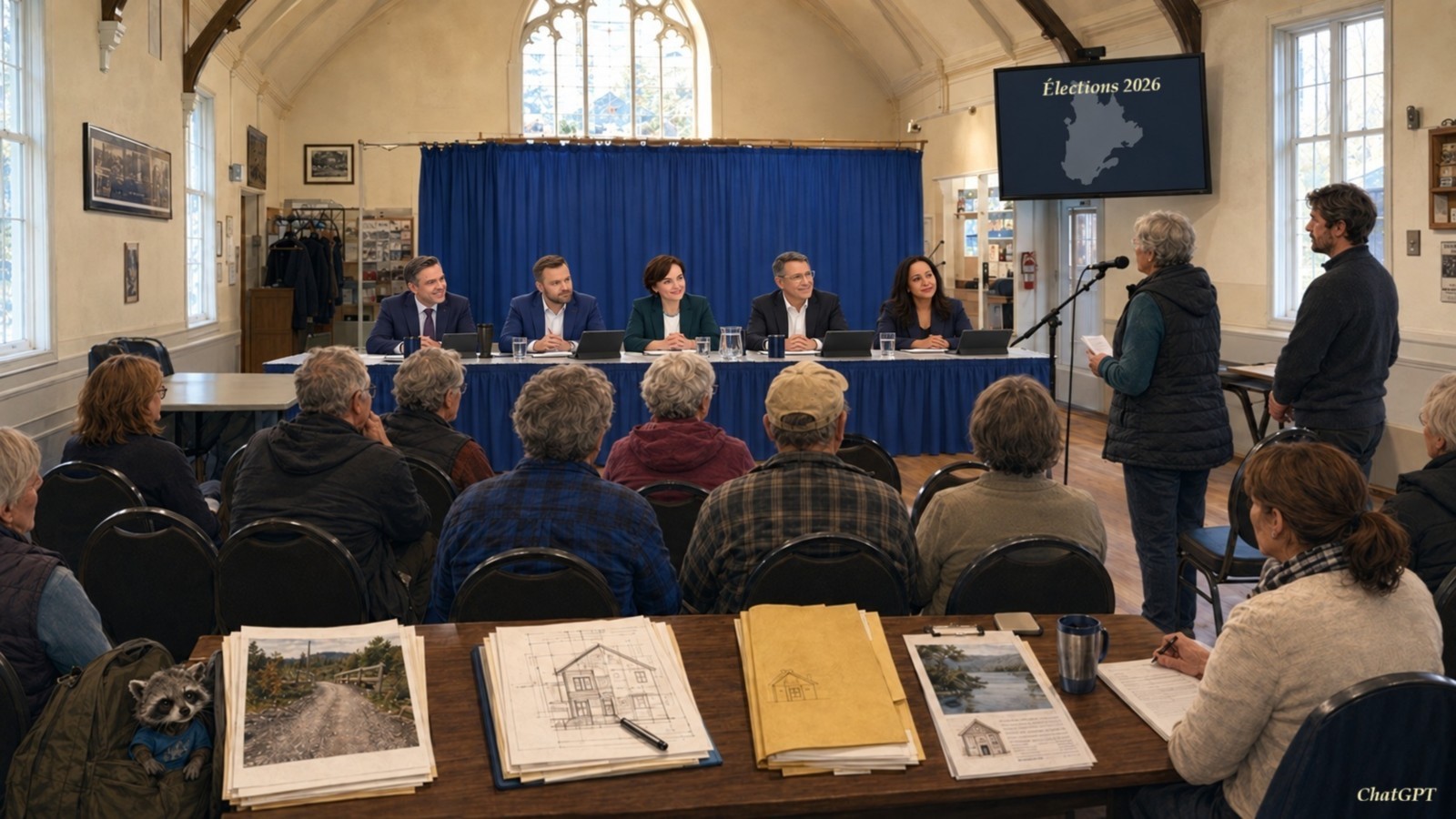
The leaders of the five parties represented in the National Assembly have just presented their commitments to Quebec municipalities at the Union des municipalités du Québec Electoral Summit. Infrastructure, housing, homelessness, mobility, the environment, climate change and municipal governance were all on the agenda.
But what would those commitments mean in practical terms for Wentworth-Nord? If our municipality were to present party leaders with its own list, what should it ask for?
1. Roads We Can Afford to Maintain
This is probably the most obvious priority. Wentworth-Nord covers a vast, sparsely populated territory crossed by an extensive network of municipal and private roads. The cost of roadwork can quickly exceed the financial capacity of such a small population.
At the April 14 meeting of the MRC des Pays-d’en-Haut council, Warden Catherine Hamé spoke of a cost of approximately $5 million for three kilometres of road in our region. Wentworth-Nord Mayor Karine Dostie was also expected to explain how Quebec’s budget restrictions affect the number of projects that can be carried out.
Will the next government provide lasting increases in funding for local roads, taking into account the number of kilometres to be maintained rather than only the number of taxpayers?
2. The Means to Protect Our Lakes
In Wentworth-Nord, the quality of our lakes is both a shared treasure, a major component of our property values and a considerable responsibility. Septic-system inspections, prevention of aquatic invasive species, boat-washing stations and scientific monitoring of water quality all create growing needs.
The Municipality and lake associations cannot shoulder the entire burden. Quebec should adequately fund the environmental responsibilities it delegates to municipalities and better regulate certain sources of pollution, including road salt and runoff into lakes.
Will the next government give small municipalities the resources they need to truly protect their bodies of water?
3. Reliable Cell Service Throughout the Municipality
In a wooded, mountainous and sparsely populated municipality, poor cell coverage is more than an inconvenience. It becomes a safety issue when a power outage occurs, an accident happens on an isolated road or someone needs to call emergency services.
Governments have spoken a great deal about universal access to high-speed Internet. That promise must now include truly reliable cell service in inhabited areas and along our roads. Private providers cannot be left alone to decide which territories deserve service.
Can the next government commit to eliminating Wentworth-Nord’s poorly served areas according to a specific timetable?
4. Services Suited to an Aging Population
Living in Wentworth-Nord generally requires a car. What happens, then, when an older person can no longer drive? Health care, shopping and many essential services are located in Lachute, Saint-Sauveur or Sainte-Adèle, sometimes a considerable distance from home.
Aging at home requires more than good intentions. It requires accessible care, on-demand transportation and, eventually, suitable housing that allows seniors to remain in their community.
Will the next government help small rural communities provide these local services?
5. Responsibilities Matched by the Necessary Resources
A small municipality must enforce a multitude of laws, standards and procedures that are often designed with little regard for the size of its administration. Every new responsibility requires staff, studies, inspections and reports. The Fédération québécoise des municipalités is calling for a moratorium on any new rule that increases the administrative burden on municipalities and small businesses.
The request could be summed up as follows: no new municipal responsibility without the corresponding funding.
And Now, What Are the Answers?
This list is clearly not exhaustive. Housing, fire protection, trails and the vitality of our three sectors also deserve the next government’s attention. Homelessness, now present in the Pays-d’en-Haut, also requires a regional response supported by Quebec, even if it is not currently one of Wentworth-Nord’s foremost local priorities. But a list that includes everything no longer sets any priorities.
Let us therefore retain five requests: affordable roads, protected lakes, reliable cell service, services for an aging population and municipal responsibilities backed by the necessary resources.
These are very concrete questions that the candidates in our riding should now answer. And if the Municipality of Wentworth-Nord has already presented the parties with its own priorities, its citizens would certainly be interested in learning what they are.
Concept and editorial direction: Carl Chapdelaine; research, analysis and writing: ChatGPT.
Wentworth Nord Council Meeting September 16, 2026, Report*
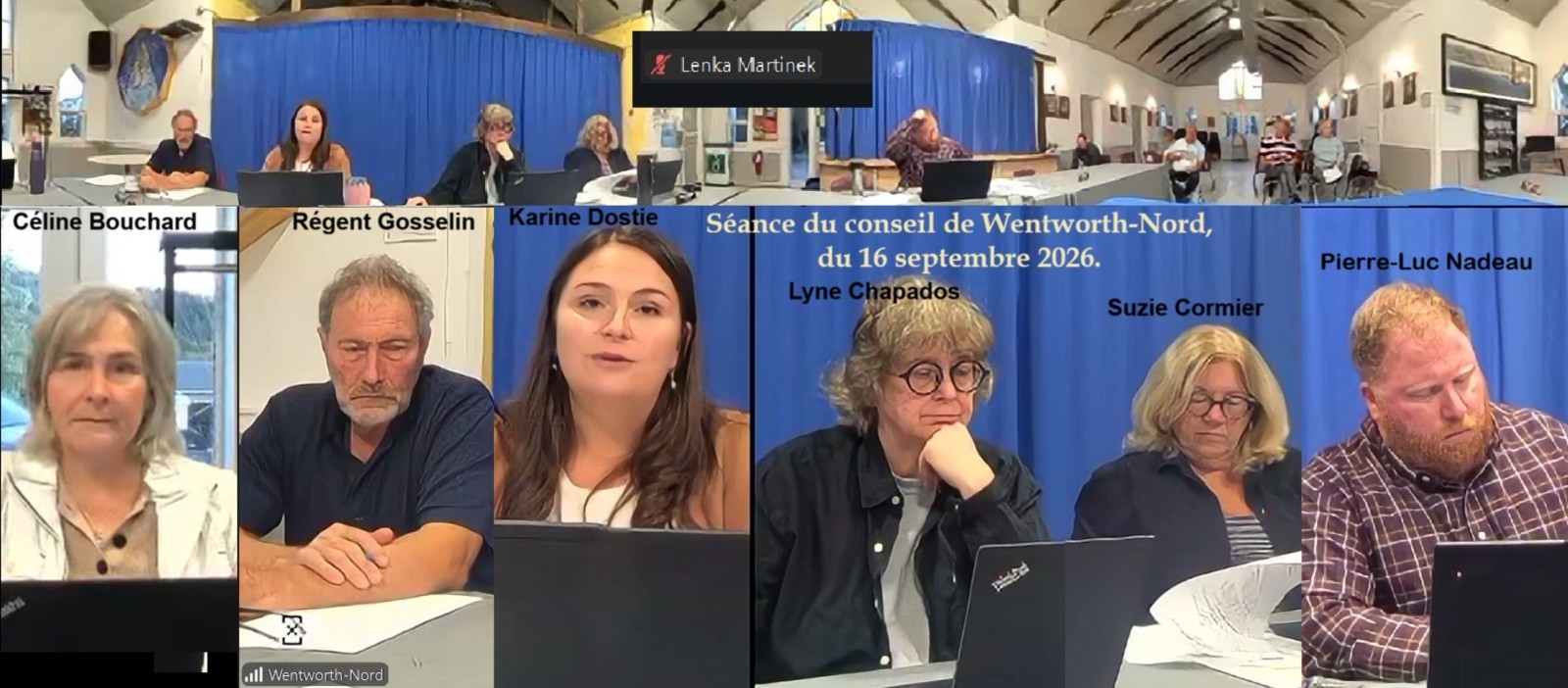
Mayor Karine Dostie chaired the meeting. At the council table were Councillors Céline Bouchard, Régent Gosselin, Lyne Chapados and Suzie Cormier, together with Pierre-Luc Nadeau, Acting Director General and Clerk-Treasurer. Alex De Zordo was absent. Lenka Martinek, who was also absent from the council table, joined the meeting by Zoom but did not speak or audibly take part in the votes.
An item was added to the agenda to authorize the first payment for the Chemin du Lac-Farmer rehabilitation work.
2 Statements by Council Members
- Chemin du Lac-Farmer Work
The work, representing an investment of more than $3 million, is proceeding on schedule, with no major unexpected problems.
The Mayor thanked residents for their patience, as well as the crews maintaining alternating traffic during construction.
- A Single Point of Contact for Residents
The Municipality is introducing a single email address for all residents' requests: info@wentworth-nord.ca.
Residents will no longer have to determine for themselves whether a question should be directed to Urban Planning, Public Works or Administration. Requests will be forwarded to the appropriate department, which should make follow-up easier.
- Opening of the Health Co-op
The Wentworth-Nord Health Solidarity Co-operative will begin receiving its first patients on Tuesday, September 22. Every Tuesday, by appointment, a nurse affiliated with the CISSS Mon parcours santé program will provide health assessments lasting approximately one hour.
An osteopath is also expected to begin offering services soon. The Municipality plans to apply for the services of a rural nurse. The Health Co-op is also recognized as a service point that could accommodate a physician.
Its Annual General Meeting will be held on Saturday, October 17, in Saint-Michel, followed by a spaghetti fundraising dinner.
- Hydro-Québec Worker Appreciates Residents' Welcome
Following an outage that required emergency work in Laurel, a Hydro-Québec worker publicly thanked the residents who brought her snacks and a sweater and took the time to speak with her. The Mayor highlighted this example of kindness toward workers called upon to intervene in the municipality.
3 Adoption of the Minutes
The minutes of the regular meeting of August 19, 2026, were adopted.
4 Administration
- Financial Position
The Mayor tabled her report on the Municipality's financial position. It will be published on the municipal website and included with the next mailing of tax bills. This approach will save several thousand dollars in postage costs. A printed copy will be available at Town Hall.
The 2025 fiscal year ended with an accounting deficit of $244,006, mainly attributable to the purchase of land and equipment financed from the accumulated surplus. The Mayor explained that this reflected a choice to increase the Municipality's operational capacity, rather than an uncontrolled overrun in current spending.
The accumulated surplus still stood at $2,791,188 as of December 31, 2025. Long-term debt amounted to $3,290,951, portions of which are assumed by the government or by the taxpayers directly concerned.
The Municipality believes that acquiring equipment enables it to carry out more work in-house, reduce its dependence on contractors and better control costs. However, rising expenditures for infrastructure and road network maintenance may require difficult choices in the coming years.
- Health Co-op
Council granted $10,000 in financial assistance to the Health Co-op. It will be paid in two instalments of $5,000, in March and June 2027.
- Pavillon Montfort Art Gallery
The Pavillon Montfort Art Gallery will receive two contributions of $250 for two separate cultural activities, for a total of $500.
- Consolidation of Borrowings
Council authorized a $380,000 bond issue. This is not a new expenditure, but the consolidation of four existing loans reaching maturity, including loans for municipal equipment and the Chemin Notre-Dame work.
5 Public Safety
In August, the Fire Department and first responders were called out for open-air fires, false alarms, assistance to paramedics, incidents involving electrical installations, and a rescue in the Montfort sector.
- Mutual Assistance with Lachute
A mutual assistance agreement was concluded with the City of Lachute for the exchange of fire protection and disaster response services. It specifies, among other things, intervention and billing arrangements between the two municipalities.
- Fire Safety Programs
Council adopted eleven programs developed with the MRC des Pays-d'en-Haut in order to comply with the future fire safety cover plan.
They concern, among other matters, public awareness, inspection of at-risk buildings, maintenance of water points and dry hydrants, equipment, training, response plans, and smoke alarm inspections.
The twelfth program, concerning fire hydrants supplied by a water system, does not apply to Wentworth-Nord.
6 Public Works
Work to restore road surfaces, gravel, asphalt and ditches is continuing. Much remains to be done before the end of the season.
- Chemin Carrière
Wentworth-Nord will provide the Township of Wentworth with grading and snow removal services for part of Chemin Carrière.
- Recreation Chalet
A contract for $21,147.33, taxes included, was awarded to waterproof the foundations of the Recreation Chalet at 3492, Route Principale, and install a French drain.
The work is intended to protect the building and allow better use of its space.
- Chemin du Lac-Farmer
Council accepted four change directives. One concerns the replacement of a culvert that did not appear on the plans, resulting in an additional expenditure of $25,136.54.
A first payment of $320,352.43, taxes included, was authorized to Pavage Multipro on the recommendation of the engineering firm supervising the work. This amount corresponds to materials already installed and part of the work completed.
7 Environment
The Municipality was represented at the Rendez-vous de la conservation held in Saint-Jérôme. Margaux Moreau, Environmental Coordinator, attended the event. The Montagne de l'Ours conservation project was among the projects presented.
8 Urban Planning
- Permits for August
The monthly list shows 68 permits*, representing a total value of more than $4.4 million in construction work. Three dwelling units were created during the month.
- Minor Variances
The three minor variances on the agenda, concerning the same cadastral operation affecting 4791, Rue Julia, as well as 4806 and 4808, Chemin de la Rivière-Perdue, were approved.
Their main purpose is to reconfigure property boundaries so that they more closely reflect the actual use of the land and to regularize the location of a septic system. They do not allow an additional residence to be added.
Reconfiguring the lot at 4791, Rue Julia, will nevertheless make it possible to replace an old, uninhabitable cottage with a new residence in the future. However, no PIIA for this reconstruction was submitted during this meeting.
- PIIA - Construction of Principal Buildings
Two PIIAs authorizing the construction of principal residences were approved:
Rue Champlain, lot 5 940 289, Domaine de la Nouvelle-France: construction of a one-storey residence. The applicant provided the requested details concerning fill and excavation work and the location of lighting. The topography justifies the proposed work, and lighting will be limited.
Rue Grilli, lot 5 938 328: construction of a two-storey residence on foundations already begun. The project was approved in 2018 and 2022, but the work was not carried out and the authorizations had expired. The architecture and massing were considered harmonious with neighbouring residences.
These two PIIAs must be included in the 2026 compilation. The Rue Grilli project is the resumption of a project already announced in previous years.
- Other PIIAs
The other PIIAs were also approved:
a rear-yard addition to the residence at 1303, Rue des Pruches;
construction of a garage at 6906, Route Principale;
a colour change and modification to part of the exterior cladding at 1609, Chemin Rozon.
- Female Dog Declared Potentially Dangerous
Following an attack that caused the death of another dog and after receiving two veterinary assessments, Council declared a female husky kept at 3849, Rue Régent-Ouest, to be potentially dangerous.
Several measures were imposed: constant supervision in the presence of children aged ten or younger; a basket muzzle and harness in public places; a leash no longer than 1.25 metres; identification indicating that the dog is reactive; exclusion from dog parks; rabies vaccination; sterilization; and microchipping.
The property must also be arranged to prevent the dog from leaving, and a sign must warn visitors of the dog's presence. Council recommended that the owner attend dog training or behavioural therapy classes based on positive reinforcement.
- Contribution for Parks Purposes
Following a cadastral operation creating two lots, Council accepted a cash contribution of $6,930 for parks, playgrounds and natural areas.
9 Trails Recreation and Community Life
- Trails
The Trails Committee will resume its work this fall. Grant-funded work must be carried out in the Montfort sector.
The Municipality is also awaiting a response to a grant application to develop a trail linking Montfort and Laurel. The designation of future trails and the possibility of forming a volunteer maintenance brigade will be part of the committee's work.
- Community Activities
Several activities were announced:
-the Soupers de la sagesse dinners, on the first Wednesday of each month;
-the Ressources communautaires community lunch, on the third Wednesday of each month;
-France Paquette's painting classes during the fall and winter sessions;
-Nordic walking;
-line dancing classes on Monday evenings;
-the film club on the third Saturday of the month; the film "Dépendances" on Saturday, September 19, with popcorn;
-the first Health Co-op appointments on Tuesday, September 22;
-the Health Co-op Annual General Meeting and spaghetti fundraising dinner on Saturday, October 17, in Saint-Michel.
-Residents wishing to propose or offer an activity are invited to contact the Municipality at info@wentworth-nord.ca.
11 Question Period
- Septic System at 1609 Chemin Rozon
A resident questioned whether the property's septic system was compliant, given that a PIIA concerning its exterior cladding had just been approved.
The Mayor replied that the matter would be verified. She explained that approval of the PIIA does not prevent the Urban Planning Department from separately requiring corrective work on the septic system.
- Access to Municipal Information
A remote participant said that some information about municipal activities and Council meetings remained difficult to find. In his view, information was scattered among the municipal website, Facebook and the newsletter. He cited, in particular, the difficulty he had experienced in finding the Zoom link for the previous meeting.
The new single email address will make it easier to submit requests to the Municipality, without necessarily resolving the entire issue of how public information is organized.
- Dog Declared Potentially Dangerous
The same participant, who knows the dog and the area, considered the imposed measures reasonable, while urging residents not to demonize the animal. He noted that such dogs may be sociable under ordinary circumstances, even though incidents require precautions.
- Residential and Commercial Noise
A resident asked whether the same noise standards apply to residential and commercial properties. She questioned the fairness of regulations that might occasionally restrict noise produced by a resident while a neighbouring business produces noise throughout the week.
The Municipality will review the applicable regulations and follow up on her request.
Report prepared by ChatGPT, under the direction and review of Carl Chapdelaine, September 17, 2026.
Readers should refer to the video recording and, once published, the official minutes for greater accuracy and detail.
Wentworth-Nord Council Meeting of August 19, 2026 — Report*

* Readers should refer to the video recording and the official minutes for greater accuracy and further details.
All members of Council are present except Councillor Lyne Chapados. Seated at the Council table from right to left, in district-number order, are Lenka Martinek (District 1), Suzie Cormier (District 2), Régent Gosselin, who has a cold (District 4), Céline Bouchard (District 5) and Alex De Zordo (District 6), along with Mayor Karine Dostie. The Mayor chairs the meeting, assisted by Pierre-Luc Nadeau, Acting Director General.
The Zoom counter will show slightly more than a dozen participants, including Council members seated at the Council table, while only two residents attend in person at the Laurel Community Centre. The meeting will last only 55 minutes.
2. Statements by Council Members
- A recognition ceremony was held to acknowledge the dedication of police officers, some of whom have already completed 20 or even 30 years of service in the region. These include Stéphane Corbeil, Chief of Operations, and Martyne Charrette, Director of Public Safety.
- Intermunicipal assistance. During the tornado on July 21, Wentworth-Nord’s services were called upon to assist those of the Municipality of Harrington. Wentworth-Nord subsequently received a letter of thanks from Harrington’s mayor and director general.
- Festival Ciel d’août. Thanks were extended to the organizers of this event, which has become a local fixture, particularly the Table de concertation des arts et de la culture. Councillor Cormier will provide further details.
- Follow-up on residual materials management. Unacceptable collection delays have been observed for several weeks, affecting both individual households and semi-underground containers. These delays are being taken seriously by both the Municipality and the MRC. The latter is communicating with the service provider and demanding a return to normal operations. Residents are encouraged to complete the complaint form on Info-Collecte.com: watch what is happening and be our eyes in this matter.
Councillor De Zordo adds that he has completed the form himself on more than one occasion. He notes that the delays tend to compound the problem: overflowing containers result in even more material having to be picked up during subsequent collections, and so forth.
Follow-up and adoption of the minutes of the regular meeting held on July 15, 2026.
Follow-up and adoption of the procès-verbal de la séance extraordinaire du 31 juillet 2026. At that meeting, Ron Kelly announced his resignation in order to pursue new challenges. Assistant Director General Nadeau then became Acting Director General.
4. Administration and Correspondence
4.1. Appointment as Director General and Clerk-Treasurer. Mr. Nadeau is officially appointed to these positions, replacing Ron Kelly. Mayor Dostie emphasizes that Council has complete confidence in Mr. Nadeau, who has worked for the Municipality for the past year.
4.2. Acceptance of the payroll, purchasing, disbursement and capital-purchase reports for July 2026. Disbursements totalled $933,000 for the month, compared with $1.2 million in July 2025. A payment to the Sûreté du Québec had been made last year (?). The current amount is in keeping with the budget.
4.3. Adoption of By-law 2026-632 concerning the publication of municipal public notices. The Municipality will stop publishing its notices in newspapers. Citizens make little use of this publication method, and discontinuing it will generate savings. Notices will continue to be posted on municipal bulletin boards and through the other prescribed channels.
4.4. Resolution supporting the Base de plein air Bon départ in its application for funding to renovate its buildings under the Programme d’immobilisation en entrepreneuriat collectif.
4.6. Appointment of an authorized representative before Revenu Québec: Mr. Nadeau.
4.7. Appointment of persons responsible for electronic services: Mr. Nadeau and the Director of Accounting, Martin Larose.
4.8. Authorization to sign documents with the Minister of Natural Resources and Forests. Mr. Nadeau is authorized to act on behalf of the Municipality regarding applications for the authorization or use of public land submitted to the Ministry. This authority will be useful, for example, in transferring a section of chemin du Lac-Gustave, currently owned by the Québec government, to the Municipality.
4.9. Establishment of temporary borrowing facilities related to borrowing by-laws. These facilities would make it possible to advance funds while awaiting the payment of approved grants (?), as in the case of the rehabilitation of chemin du Lac-Farmer.
4.10. Fundraising campaign by Nouvelle vague municipale : contribution of $45.
4.11. Donation request from the La Sagesse group for advertising on the sign at Saint-Michel Church: $700.
5. Public Safety
5.1. Report from the Chair of the Public Safety Committee. In Councillor Chapados’s absence, Mayor Dostie presents the main points of her report.
Open-air fires were lit without permits. There was also a vehicle fire and several road accidents. Under intermunicipal mutual-aid arrangements, residents may see a vehicle from Brownsburg or another municipality travelling through Wentworth-Nord.
Mayor Dostie returns to the fire department’s residential visits. The Municipality is required to conduct this type of prevention activity. Residents are encouraged to complete any questionnaire that may have been left at their door while they were away and return it to the Municipality.
6. Public Works and Municipal Asset Management
6.1. Report from the Chair of the Roads Committee. Councillor Gosselin reports that some of the schedule delays caused by unfavourable weather have been made up.
6.2. Authorization to submit an application for financial assistance under the Support component of the Programme d’aide à la voirie locale (PAVL) for the rehabilitation of Lanthier Bridge.
6.3. Authorization of a similar application for the rehabilitation of chemin des Montfortains. Mayor Dostie says the Municipality should know in January whether the grant has been approved.
6.4. Awarding of a contract for the supply of crushed stone. Five bidders submitted proposals, including two located within Wentworth-Nord. The suppliers’ distance from the Municipality was taken into consideration because transportation accounts for a significant portion of the cost.
7. Environment
7.1. Report by Councillor Martinek.
- Inspection of septic systems. An inspection would be mandatory no later than 45 years after installation (?). A total of 182 notices have been sent. The requirement and its implementation have prompted extensive discussion with residents. Bringing these systems into compliance would provide significant environmental benefits for our lakes.
- Watercraft washing. Statistics available through the end of July reportedly show approximately 1,000 washes (?). The system is not perfect: some users simply drive past the washing stations. The Municipality hopes to provide more monitoring next year and to recruit more volunteers.
8.1. Report presented by Mayor Dostie in Councillor Chapados’s absence.
8.2. Tabling of the list of permits issued from July 1 to 31, 2026.
8.7. SPAIP 2026-0355 — Construction of a principal building on lot 6 511 931, rue du Forestier, in the La Musarde sector.
8.9. SPAIP 2026-0312 — Installation of ground-mounted solar panels at 1436 chemin du Hâle. Mayor Dostie explains that solar panels prompted considerable discussion, including the clearing required for their installation compared with the benefits of solar energy. In this case, the installation does not appear to create a visual nuisance for residents of Lac Notre-Dame. The applicable by-laws may eventually have to be amended to encourage the use of this clean energy source.
8.11. Acquisition by the Municipality of Québec cadastre lot 6 697 740, in connection with chemin Hunter. The acquisition will give the Municipality ownership of the entire road right-of-way and resolve problems involving its maintenance. The owner is transferring the lot to the Municipality.
9. Recreation, Culture and Community Life
9.1. Report from Councillor De Zordo, Chair of the Health and Outdoor Activities Committee.
- Quotations are being obtained for the upgrading of the Sentier des Orphelins. The work may be more extensive than originally anticipated. It is still hoped that the project, overseen by SOPAIR, can be carried out in the fall.
- Following numerous discussions with the principal stakeholders, the Municipality is awaiting a response to its grant application for an extension of the trail toward Lac Wentworth and the creation of a loop toward Laurel. Since the application review will take several months, the project could proceed in 2027 if funding is approved.
- The Age-Friendly Municipality survey. Some residents are not entirely sure what the initiative involves. They are invited to share their understanding of it. The survey process will continue through September, and a considerable amount of compilation work is under way.
- Back-to-School Celebration. The event held today at Camp Péniel welcomed 256 people.
- Saint-Jean-Baptiste Day celebrations drew a good turnout. The overall assessment is very positive.
- Festival Ciel d’août. This was the festival’s fourth edition. Several organizations contributed, and attendance reached a record level. A special day was held in each of Wentworth-Nord’s three sectors: Saint-Michel, Laurel and Montfort.
- The Ciné-club will resume its activities on September 19. Screening dates will be posted in advance.
- Laurel Beach (?). Lifeguard supervision will be reduced as students return to school.
- Many activities will resume in September, including Nordic walking and the La Sagesse dinners.
- The Coop Santé will hold its annual general meeting on September 26.
Mrs. Rioux clarifies that the La Sagesse dinner will take place on Wednesday, September 2.
Mr. Rousseau thanks Council.
By Carl Chapdelaine
When “Statements by Council Members” Influence Question Period

A New Dynamic at Wentworth-Nord Council Meetings
In our retrospective on fifteen years of Question Periods at Wentworth-Nord municipal council meetings, we considered Question Period a distinct part of the proceedings, held near the end of each meeting and reserved for citizens’ interventions. A recent change in the way meetings are conducted, however, requires us to qualify that interpretation.
Since 2025, “Statements by Council Members,” near the beginning of the meeting, have increasingly been used to present current municipal issues. Several of these subjects are subsequently taken up by citizens. Question Period is therefore no longer driven solely by their spontaneous concerns: it is also prepared—and sometimes influenced—by the information the council has just provided.
An Existing Item Takes On a New Function
“Statements by Council Members” was already an item on the agenda. It was used irregularly, however, for congratulations, expressions of thanks, personal positions or special statements by individual council members.
“Public-Interest Matters,” near the end of the meeting, could have been used to provide updates on current municipal affairs. But this item generally remained empty or contained little of substance. It was sometimes used to add a resolution or allow a council member to revisit a debate.
A change began on March 19, 2025, when Danielle Desjardins proposed adding five minutes to council meetings to inform residents about matters of public interest.
After becoming mayor, Karine Dostie instead moved this informational function to the beginning of the meeting, under “Statements by Council Members.” In our report on the September 17, 2025 meeting, we explicitly described this as a “new format.”
That day, the statements addressed the reconstruction of chemin du Lac-Farmer and chemin des Montfortains, the RCM’s work on rue du Chemin-de-Fer, support for lake associations, the Fire Safety Department, snow removal on certain private roads and traffic on route Principale.
The item thus became a kind of condensed municipal news bulletin. It allows the council to provide an update without necessarily submitting a resolution, remind residents about a consultation, announce a follow-up or alert them to a situation likely to affect them.
Statements Subsequently Taken Up by Citizens
A comparison with Question Period shows that certain subjects presented at the beginning of a meeting are subsequently taken up directly by citizens.
On November 19, 2025, during the first meeting of the new council, the mayor discussed, among other things, the equalization of the property assessment roll, work on Chemin-de-Fer, the possible effects of the Montée Sainte-Marie project on Wentworth-Nord and developments involving the Coop Santé.
During Question Period, Denyse Pinsonneault asked why the new assessment had resulted in a sharp increase in land values while the value of some homes had apparently decreased.
The undersigned returned to the Montée Sainte-Marie project and its possible effects on traffic along the Aerobic Corridor and at Lake Saint-François-Xavier. He asked what measures would be taken to protect the lake against excessive use.
Another participant questioned the council about the Coop Santé.
The statements did not prevent questions from being asked about these matters. Instead, they provided an initial body of information on which citizens could base their requests for clarification.
The connection was even clearer at the July 15, 2026 meeting. At the beginning of the meeting, the mayor announced that reconstruction work on chemin du Lac-Farmer was scheduled to begin on August 3.
During Question Period, Myriam Rioux, who explained that she had missed the beginning of the meeting, asked for information about that very work. The mayor had to repeat what she had already announced. Ms. Rioux then asked why the yellow centreline had been painted before part of the road was rebuilt. The Director General explained that it had been done as a safety measure.
General information provided at the beginning of the meeting thus led to a more specific question about its implementation. This example also reveals a very simple limitation: a statement may be missed by late arrivals or by those who join the videoconference after the meeting has begun.
A Useful Format That Also Influences the Debate
Moving current information to the beginning of the meeting has nearly deprived “Public-Interest Matters” of its purpose. In June 2026, we noted that the item had effectively become redundant.
The new arrangement has an obvious advantage. Current issues are presented while participants are still fully attentive, rather than after administrative reports, bylaws and resolutions. Citizens can then ask about what was not explained, raise an overlooked consequence or request a follow-up.
The format also reflects the mayor’s desire to make meetings more dynamic and leave more time for questions. In December 2025, one citizen even jokingly asked whether the faster pace was intended to set a record.
This approach nevertheless creates a kind of informal agenda. By choosing the subjects addressed in their statements, council members necessarily draw attention to certain concerns, which citizens are then naturally inclined to take up.
The statements also remain a one-way presentation: the council chooses the issues, the information it discloses and the way it presents them. Question Period therefore retains its critical role.
Moreover, not every intervention stems from these statements. Citizens continue to raise individual concerns involving permits, snow removal, waste collection, roads or access to services. They can also introduce an issue that the council did not place in the spotlight.
Conclusion
The new format alters Question Period before it even begins. The council presents current issues; citizens can then revisit, clarify or challenge them.
“Statements by Council Members” therefore enrich Question Period, but they also influence its content. They do not replace it: they prepare part of it, while citizens remain responsible for introducing the issues that the council itself has not chosen to highlight.
By ChatGPT, based on an idea and documentation provided by Carl Chapdelaine
Fifteen Years of Question Periods at Wentworth-Nord Council Meetings

A Preliminary Analysis of Meeting Reports, 2011–2025
An examination of the reports prepared by the Friends of Lake Saint-François-Xavier reveals much more than a succession of unrelated questions. In a sense, Question Period acts as a seismograph of municipal life: the same problems resurface over the years, but their intensity, wording and the way council responds to them change from one administration to another.
One conclusion already stands out: citizens rarely ask abstract questions about the overall future of Wentworth-Nord. They generally intervene when a road, lake, permit, property assessment or municipal decision affects them directly.
An Important Documentary Limitation
The available material does not allow us to count accurately every question asked over the fifteen-year period.
• From 2011 to 2014, the reports are often incomplete and focus primarily on Montfort and Lake Saint-François-Xavier.
• The years 2015 to 2017 are scarcely documented in the files retrieved.
• The reports become more numerous in 2018 and 2019.
• Beginning in 2020, and especially in 2021, they become much more systematic.
• Since 2022, the number of participants in the meeting room or by videoconference has been recorded fairly often.
Consequently, an increase in the number of questions reported does not necessarily mean that citizens asked fewer questions in earlier years. It also reflects the improvement of the reports and the advent of video recordings.
Special meetings, budget meetings, public consultations and information sessions were excluded from this analysis.
The Major Periods
Period Dominant Character of Question Period
2011–2014 Local problems and specific requests, particularly in Montfort
2015–2017 Insufficient documentation
2018–2019 Expansion to broader municipal choices
2020–2021 Governance crisis and transformation through videoconferencing
2022–2023 Return to a more administrative and structured format
2024–2025 Territorial issues, lake access, roads and urban planning
1. From 2011 to 2014: A Very Local Question Period
The earliest documented years show Question Period being used mainly to obtain information or put pressure on council concerning very specific problems.
The most visible topics include:
• the condition of Chemin de Montfort;
• the shared roadway and the Aerobic Corridor;
• Newaygo Bridge;
• sand being carried into the Pavilion Basin;
• parking and access to the beach;
• Chemin du Lac-Thurson;
• traffic and safety;
• certain municipal projects affecting Montfort.
In January 2012, the deplorable condition of Chemin de Montfort even led to a proposal to establish a citizens’ committee responsible for organizing pressure on the authorities. In April 2012, approximately thirty people attended the meeting held at the Pavilion—an exceptional turnout.
In September 2014, questions from the lake delegation once again concerned the Corridor, Newaygo Bridge, the accumulation of sand in the lake and parking at the beach.
At that time, Question Period fulfilled three roles:
1. obtaining an update on a file;
2. reminding council of an earlier promise;
3. pressing the Municipality to intervene with another authority, particularly the Ministry of Transport.
The exchanges generally appear to have been courteous. Answers could be vague or announce another delay, but the conduct of the meeting itself was still rarely challenged.
This first period is nevertheless distorted by the nature of the sources: the reports were then intended primarily for the Friends of Lake Saint-François-Xavier. They therefore naturally place Montfort and the lake in the foreground.
2. From 2018 to 2019: From Local Problems to Municipal Choices
Beginning in 2018, the range of subjects broadens. Citizens no longer question council solely about the execution of a particular project; they increasingly question municipal priorities.
The issues raised include:
• the general condition of the road network;
• financing its rehabilitation;
• tax increases;
• economic development;
• permits and zoning;
• municipal services;
• Internet access;
• lakes and the environment.
Road conditions remain the dominant issue, which is hardly surprising in such a large municipality. However, Question Period also becomes a place where different visions of municipal development confront one another: maintaining infrastructure at minimum cost or rebuilding it sustainably; developing or protecting; investing or limiting debt.
3. The Year 2020: The Great Upheaval
The pandemic profoundly transforms Question Period.
Videoconferencing allows more people to attend meetings without having to travel to Laurel. A single connection may also represent more than one person; potential participation can therefore be considerably greater than the on-screen count suggests.
Recordings have another effect: citizens who were absent can watch the meeting afterwards and learn more precisely what was said, particularly during Question Period. They can verify the answers given by elected officials, follow the development of a file and, eventually, prepare an intervention for a subsequent meeting. Videoconferencing therefore broadens not only immediate participation, but also lasting access to municipal debate.
At the same time, access to the floor becomes more regulated:
• questions submitted by email;
• uncertainty over which questions will be accepted;
• microphones being turned on or off;
• limits on the number or length of interventions;
• debate over whether questions must relate to the agenda;
• difficulty distinguishing a question from a comment.
The content of Question Period is then dominated by two groups of issues.
The first concerns municipal matters: closure of the beach, a telecommunications tower, property assessment, Internet service, roads and the pandemic.
The second concerns council itself. Conflicts between Mayor François Ghali and certain councillors spill over into the period reserved for citizens. Questions become a means of challenging one version of events, defending an elected official or denouncing a decision.
Question Period therefore ceases to be merely an exchange between citizens and council. It becomes, in part, a public extension of council’s internal divisions.
4. The Year 2021: The Height of the Governance Crisis
The trend that began in 2020 continues in 2021. Ordinary municipal issues remain present, but questions concerning governance, the mayor’s powers, administrative decisions, relations among elected officials and the involvement of the Commission municipale du Québec occupy an exceptional amount of attention.
This period demonstrates the extent to which the format can be diverted from its normal purpose. Instead of simply asking:
What is the status of this file?
interventions often attempt to establish:
Who is telling the truth? Who had the authority to act? Who is responsible?
Question Period thus becomes a kind of improvised political tribunal. It promotes transparency, since disputes can no longer remain entirely behind closed doors; but it also lengthens meetings and sometimes makes it difficult to discuss citizens’ more ordinary concerns.
5. From 2022 to 2023: Normalization and Professionalization
Under Danielle Desjardins’s new administration, Question Period gradually returns to a more administrative format.
Hybrid meetings become established. The Zoom counter frequently shows approximately thirty participants, sometimes joined by ten or fifteen people in the meeting room.
Answers are increasingly shared among:
• the mayor;
• Director General Ron Kelley;
• Benoît Cadieux for urban planning and environmental matters;
• councillors responsible for certain committees.
This participation by the administration often provides more precise answers. However, it also makes Question Period more technical.
The principal concerns are:
• maintenance and municipal takeover of roads;
• permits, subdivisions and PIIA applications;
• short-term rentals;
• real estate developments;
• lakes and access to them;
• environmental regulations;
• finances and taxation.
The February 15, 2023 meeting provides a particularly good example of the educational—and sometimes corrective—role of Question Period. The tabling of a draft by-law concerning tourist accommodation in a principal residence is understood by several participants as a much broader measure against short-term rentals. Question Period, which occupies approximately half of a meeting lasting more than two hours, is used to clear up this misunderstanding.
This illustrates another essential function: correcting what the highly legalistic reading of a draft by-law has failed to make clear to the public.
The rules are also tightened: one question at a time, raising one’s hand on Zoom, waiting for the designated period and avoiding lengthy comments. This discipline facilitates the conduct of the meeting, but it can frustrate a citizen attempting to explain a complex problem.
6. From 2024 to 2025: Territorial Issues at the Heart of the Questions
During the final two complete years, three broad groups of issues clearly dominate.
- Roads
Public, private and shared roads remain omnipresent:
• maintenance;
• the respective responsibilities of the Municipality, the RCM and the MTMD;
• municipal takeover of private roads;
• Chemin du Lac-Farmer;
• Rue du Chemin-de-Fer;
• road safety;
• asphalt or gravel.
In July 2025, an emotional intervention by the spokesperson for residents of Rue du Chemin-de-Fer occupies a considerable portion of Question Period—almost half of a meeting lasting slightly more than an hour and a half.
This repetition shows that citizens often come before council when institutional responsibilities are shared or poorly understood. The Municipality may reply that it is not solely responsible; but for residents, it remains the most accessible public authority.
- Lakes and Access to Them
In May 2024, Question Period is devoted almost entirely to a delegation from Lac Argenté opposed to the application of directives favouring public access to lakes.
The arguments raised—property rights, environmental protection, disturbances and municipal costs—foreshadow precisely the debate that continued in 2025 and 2026.
Question Period reveals a fundamental characteristic of Wentworth-Nord: citizens often defend their lake as the common territory of a particular group, but not necessarily as a shared municipal resource.
- Urban Planning
Permits, processing delays, subdivision applications, PIIAs, building materials and architectural integration regularly prompt interventions.
Some of these questions concern individual applications. Their recurrence nevertheless reveals broader problems:
• regulatory complexity;
• perceived delays;
• difficulty determining the status of a file;
• misunderstanding of the respective roles of the Planning Advisory Committee, the administration and council.
Question Period therefore sometimes serves as a last-resort service counter when a citizen feels that the usual administrative process has led nowhere.
The Most Recurring Subjects
Without claiming to provide a scientific count of every intervention, the general order clearly emerges:
1. Roads and transportation
2. Lakes, the environment and access
3. Urban planning, permits and real estate development
4. Governance and the functioning of council
5. Finances, taxation and property assessment
6. Recreation, community buildings and heritage
7. Telecommunications
8. Public safety and emergency services
Roads and lakes are the two enduring concerns. The prominence of other topics rises and falls according to municipal events.
Who Takes Part?
The reports suggest that a relatively small number of citizens intervene regularly. High attendance occurs mainly when a group is mobilized by a specific issue:
• a road;
• a lake;
• a planning by-law;
• a tax increase;
• a political controversy;
• a project directly affecting one sector.
Participation is therefore more reactive than continuous.
Videoconferencing has unquestionably broadened the audience. Approximately thirty Zoom connections are frequently recorded in the 2022 and 2023 reports. Watching a meeting, however, is not the same as speaking. The number of speakers generally remains far lower than the number of participants.
What Do Citizens Actually Obtain?
Council’s responses can be divided into four main categories:
Type of Response - Usual Result
Immediate information - The file or rule is explained
Referral to the administration - The citizen must contact a department director
Promise to investigate or follow up - The result does not always appear in the following meeting report
Lack of direct municipal authority Responsibility is attributed to the RCM, the MTMD, the government or a property owner
Question Period is therefore effective for obtaining an explanation. It is much less effective in guaranteeing a decision or follow-up.
This is probably its principal weakness: the same questions recur because earlier answers have not always produced a visible result.
Preliminary Conclusion
Over fifteen years, Question Period has evolved from a local exchange, held before a few residents and devoted mainly to immediate problems, into a hybrid forum that is accessible remotely, more highly regulated and much better documented.
It fulfils several functions:
• an information counter;
• a mechanism for holding elected officials accountable;
• a forum for demands;
• a means of mobilizing one sector;
• a release valve during conflicts;
• a last resort when the administration is considered slow or inaccessible.
It does not yet constitute genuine citizen participation in shaping decisions. Most often, citizens intervene once a problem already exists, a project is well advanced or a decision is about to be made.
Question Period allows citizens to react to municipal life; it gives them far fewer opportunities to help define it.
Note: A forthcoming article will examine how the new use of “Statements by Council Members” at the beginning of meetings now influences the subjects raised during Question Period.
By ChatGPT, based on an idea and documentation provided by Carl Chapdelaine
Wentworth-Nord Council Meeting of July 15, 2026 — Report*

*Readers should refer to the video recording and the minutes for greater accuracy and detail.
All council members are present. From right to left at the council table, in district-number order: Lenka Martinek (District 1), Suzie Cormier (District 2), Lyne Chapados (District 3), Régent Gosselin, who has a cold (District 4), Céline Bouchard (District 5), and Alex De Zordo (District 6). Also present are Mayor Karine Dostie, who chairs the meeting, assisted by Ron Kelley, Director General, and Pierre-Luc Nadeau, Assistant Director General.
The Zoom participant count shows just over a dozen people, including council members seated at the council table, while only three residents attend in person at the Laurel Community Centre. The meeting lasts less than 45 minutes—a record for brevity.
2. Statements by Council Members
Mayor’s Coffee Meeting of July 13. Two topics were on the agenda: urban planning and lake access. Mayor Dostie describes the event as a great success, with more than 25 residents and council members participating. A great deal of information was gathered, and considerable work will be required to take it into account. A summary of each of these Coffee Meetings will be published.
Chemin du Lac-Farmer rehabilitation project. Work is scheduled to begin on August 3, following the construction holiday. A roadwork information notice will be posted for public consultation.
Preparatory work on Route Principale by the MTMD, from Chemin des Montfortains to approximately 500 metres west of Chemin du Lac-Capri. This includes the curve at Dubois—in other words, the most problematic section. A news release announcing the work will be issued tomorrow. “Let us hope that, in 2027, we will be at the construction stage!”
3. Follow-up and Adoption of Minutes
3.1. Follow-up and adoption of the minutes of the regular meeting held on June 17, 2026.
3.2. Follow-up and adoption of the procès-verbal de la séance extraordinaire du 22 juin 2026
Tabling and acceptance of the 2025 financial statements and the external auditor’s report.
Awarding of the contract for worksite supervision during the rehabilitation of part of Chemin du Lac-Farmer.
4. Administration and Correspondence
4.1. Acceptance of the payroll, purchasing, disbursement and capital expenditure reports for June 2026. Disbursements totalled $561,000 for the month, compared with $969,000 in June 2025.
4.2. Notice of motion and tabling of draft bylaw 2026-632 concerning the publication of municipal public notices. As a cost-saving measure, only essential notices will now be published.
4.3. Funding application for property roll number 2981-11-5462 under the Écoprêt Program. Mayor Dostie notes that Councillor Chapados initiated the expansion of the program to Wentworth-Nord to make this type of financing possible.
4.4. Commitment pact for reuse—that is, the establishment of a system for reusing items their owners no longer need. The municipality has already announced plans to establish a reuse centre, possibly near the municipal garage.
5. Public Safety
5.1. Report by the Chair of the Public Safety Committee, Ms. Chapados. Once again, the councillor prefers to let the mayor present her report, as she is convinced the mayor does it better.
As usual, firefighters and first responders received calls concerning open fires, false alarms and other incidents. Mayor Dostie explains that, as they do every four years, firefighters will visit homes to provide advice and information. If no one is home, residents may instead find a pamphlet at their door containing a self-assessment questionnaire and an evacuation plan.
Councillor Chapados also wishes to highlight the municipality’s cooperation with the Brownsburg-Chatham Fire Department.
6. Public Works and Municipal Asset Management
6.1. Report by the Chair of the Roads Committee. Mr. Gosselin reports:
Road maintenance has fallen behind because of the heavy rainfall.
Unless he is mistaken, line painting and dust-suppressant application have been completed.
The planned contracts have been awarded.
6.2. Authorization to submit an application for financial assistance under the Fonds de sécurité routière (PAFFSR). With a municipal contribution of $2,500, the municipality will receive an $8,000 grant, Mayor Dostie explains. The project includes, among other things, a speed display sign.
7. Environment
7.1. Ms. Martinek presents her report.
The Environmental Advisory Committee (CCE) is taking a break in July.
The lake-access discussions at the Coffee Meeting provided considerable insight into the issue. The information gathered will be shared and used in preparing a plan or assessing a possible course of action. Lake access is currently one of the municipality’s largest environmental files.
Forests are our second most important file, and we will also be focusing on them.
Other files also have environmental implications, including the reuse initiative discussed earlier.
8. Urban Planning and Economic Development
8.1. Report by Ms. Chapados.
At the Coffee Meeting, there were many requests to ease the regulations governing such matters as permits and site planning and architectural integration programs (PIIA). The municipality has heard these concerns and will seek ways to address them.
8.2. Tabling of the list of permits issued from June 1 to 30, 2026. A total of 62 permits were issued for work valued at $1.7 million. The season is off to a strong start and is demanding the full attention of the staff responsible.
8.3. Adoption of Bylaw No. 2017-498-31, amending Zoning Bylaw 2017-498 to allow forestry operations in agroforestry zones AF-08 and AF-10. These are two of the four zones concerned. Two public consultations were held, and the draft was amended in response to residents’ concerns. No request for a referendum was received.
8.4. Adoption of Bylaw No. 2017-498-33, amending Zoning Bylaw 2017-498 to create a commercial zone within residential zone H-22, in Domaine de la Musarde, to permit “tourist accommodation” use. A public consultation was held, but no request for a referendum was received.
PIIA: Three new principal-building construction projects.
9. Recreation, Culture and Community Life
9.1. Councillor De Zordo, Chair of the Health and Outdoor Recreation Committee:
Bids are being received for the upgrading of the Sentier des Orphelins. It is hoped that the work, overseen by SOPAIR, will take place this fall.
A grant application has been submitted for an extension of the trail toward Laurel. Since the review process is expected to take several months, the project could proceed in 2027 if the application is approved.
9.2. Ms. Suzie Cormier, Chair of the Community Life, Recreation and Culture Committee:
A reminder that the Lac-Laurel beach is open. Construction of the much-discussed cave-like changing room is progressing well.
Residents are reminded to complete the Age-Friendly Municipality (MADA) survey and encourage their neighbours to do so.
The Ciel d’août festival begins on July 25. Thanks are extended to the Table de concertation des arts et de la culture.
A cultural day will be held in Laurel in conjunction with a garage sale designed to encourage the reuse of items people no longer want. More information is available on the municipal website and Facebook page, and will eventually be posted on community bulletin boards.
Question Period
Pierre Nantel (?), a visitor attending in person, says that he hopes to become the Parti Québécois candidate in the riding. He asks about the status of the proposal to convert roads in Wentworth-Nord to gravel, which was featured in a Radio-Canada report.
According to Mayor Dostie, the report explained that Route Principale had deteriorated to such an extent that it was reasonable to ask whether, in some cases, a well-maintained gravel road might be preferable to a continuously deteriorating paved surface. The discussion was not specifically about removing the pavement from Route Principale, but rather about reconsidering the paving strategy for certain municipal roads. The mayor now clarifies that only a few small roads should be gravelled.
Ms. Myriam Rioux, participating by Zoom, apologizes for missing the beginning of the meeting and asks for details about the Chemin du Lac-Farmer rehabilitation project mentioned under Statements by Council Members. See that item for Mayor Dostie’s response.
Ms. Rioux then asks why the yellow centre line was painted before rehabilitation work was carried out on part of the road. Ron Kelley explains that it was done for safety reasons.
Subject to correction; by Carl Chapdelaine
Urban Planning and Lake Access


Community Coffee Meeting – July 13, 2026
A record turnout marked this Community Coffee Meeting, with residents from all three sectors of Wentworth-Nord represented. With the exception of Councillor Régent Gosselin, all members of Council were present, including Councillor Lyne Chapados, Chair of the Urban Planning Advisory Committee (CCU), Councillor Lenka Martinek, Chair of the Environmental Advisory Committee (CCE), as well as Mr. Benoît Cadieux, Director of Urban Planning and Environmental Services.
Following introductions, participants explained what had brought them to Wentworth-Nord or what had attracted them to the municipality and its lakes. Environmental concerns ranked among the most frequently mentioned interests. Most participants were clearly lakeshore property owners.
- Urban Planning
Urban planning was the first topic on the agenda. The Mayor began by pointing out that no one had yet mentioned the issue of building permits. Her remark immediately sparked the first major discussion.
Some participants argued that municipal regulations had become overly restrictive and that permit approval times were too long. According to them, several people had even abandoned their construction projects in Wentworth-Nord. They believed that homeowners should remain free to choose the style, height and colour of their future homes.
Others, including the undersigned, supported regulations that are sufficiently rigorous to preserve a certain degree of architectural harmony.
The discussion highlighted two equally legitimate viewpoints:
• Property owners' freedom: "It's my property; I should be free to build the home I want."
• Collective responsibility: Every new house also changes the landscape shared by the entire community.
The question therefore remains: where should Wentworth-Nord position itself between these two principles?
As she regularly does, Mayor Dostie reviewed the respective roles of the Urban Planning Advisory Committee (CCU)—whose work had been questioned during the discussion—and Municipal Council in administering the PIIA (Site Planning and Architectural Integration Program) and issuing building permits.
Earlier in the meeting, the Mayor had also emphasized the importance of the Urban Planning Master Plan, its purpose, and its ongoing revision, particularly in light of climate change.
Unfortunately, time ran out before we could present what we felt was an original idea: using artificial intelligence as part of the revision of the Urban Planning Master Plan.
Climate change is now considered in virtually every planning exercise. Artificial intelligence, however, offers a new tool capable of testing various development scenarios, analyzing changes across the territory, assessing the impacts of different planning choices, and even producing visual simulations of their long-term consequences before they are implemented. - Lake Access
The subject of lake access generated just as much interest and just as many opposing viewpoints, often involving the same participants.
From the outset, some argued that they had invested considerable effort and resources to acquire waterfront property and therefore deserved to enjoy its benefits.
Others took the opposite view, maintaining that no lake is private and that everyone should be able to enjoy access, provided that visitor numbers are properly managed through regulations, quotas or other control measures. In their opinion, the real issue is not whether access exists, but how that access is managed.
Mrs. Denyse Pinsonneault clearly explained the situation at Lake Saint-François-Xavier. While she did not oppose welcoming visitors, she felt that controlled access and an entrance fee could form part of the solution. It was also suggested that some visitors be directed toward other lakes.
We asked whether the municipality might one day study the possibility of acquiring the small, still undeveloped Thurston Lake, located between Lakes Saint-Victor, Notre-Dame and Saint-François-Xavier, with the long-term objective of creating a public beach comparable to Jean-Guy-Caron Municipal Beach on Lake Rond in Sainte-Adèle.
That beach is said to accommodate up to 450 visitors and offers rentals of paddleboards, tandem kayaks and canoes. The Mayor, however, reminded participants that Wentworth-Nord's financial resources are far more limited than those of Sainte-Adèle.
Failing such a project, the municipality might perhaps make use of its new right of first refusal to acquire, when opportunities arise, land that could eventually provide genuine public access to a lake. Here again, the Mayor pointed out that such initiatives also involve significant costs.
During the discussion, Councillor Lenka Martinek observed that swimming, canoeing, kayaking and paddleboarding generally have little impact on the environment. It was also suggested that visitors may not be the primary cause of declining lake quality and that motorized boats used by shoreline residents and other lake activities may sometimes have a greater environmental impact.
Could the municipality intervene in other ways? For example, by improving the management of access points or by publishing, for each lake, a map accompanied by a code of conduct distributed to all users? Once again, the Mayor cited the municipality's limited resources.
One participant then raised the possibility of private-sector involvement. The Canadian Tire summer camp, located between Laurel and Saint-Michel, was mentioned as an example, leading the Mayor to suggest that partnerships of this kind might deserve further consideration.
What solutions are realistically within reach for a municipality the size of Wentworth-Nord?
Several intermediate options may exist: partnerships with community organizations or private businesses, visitor contributions, financial assistance from the MRC, government grants, greater involvement by lake associations, or educational tools such as those discussed during the meeting.
Wentworth-Nord probably does not have the financial capacity to purchase multiple properties and operate several public beaches on its own. However, it could encourage or support initiatives led by partners. Private-sector partnerships can certainly be part of the solution without replacing true public access, since their services are generally intended for a limited clientele. - Conclusion
This Community Coffee Meeting attracted an excellent turnout. Discussions were lively, sometimes spirited, and many worthwhile ideas were expressed. The comments gathered will undoubtedly contribute to the reflections of Council and the municipal administration.
It now remains to be seen what concrete follow-up the municipality will give to this consultation. As one participant pointed out, many of these issues have been discussed for years, while solutions have been slow to emerge.
Nevertheless, the discussions showed that perspectives are evolving. The right of first refusal, improved management of lake use, partnerships with community organizations or the private sector, and the diversification of public access points are now part of the ongoing conversation.
Beyond the differences of opinion expressed, the meeting demonstrated that most participants shared a common objective: preserving the quality of life and the natural character of Wentworth-Nord while reflecting on the best ways to ensure its future.
By Carl Chapdelaine
Fifteen Years of Public Participation at Wentworth-Nord Municipal Council Meetings

Municipal council meetings are often the best indicator of a community's democratic life. They allow residents to observe their elected officials, ask questions, and sometimes influence municipal decisions.
But who actually attends these meetings? Are meeting rooms full? Has videoconferencing changed participation? Do citizens become more involved when debates grow more contentious?
After reviewing fifteen years of reports published by The Friends of Lake Saint-François-Xavier and their archives, a remarkably consistent picture emerges.
Public participation appears to follow major municipal issues far more closely than the passing years themselves—and closely reflects the changing political climate.
Ten Meetings That Shaped Wentworth-Nord (2011–2026)
May 19, 2013 — A Packed Hall at Montfort Pavilion
Nearly one hundred residents attended the presentation of the feasibility study on access roads and septic systems for properties without road access.
Few municipal projects have generated such interest. Engineers presented several possible scenarios before lengthy discussions continued around the plans displayed on the pavilion walls.
2014–2015 — The First Major Debates on the Aerobic Corridor
Questions concerning rights-of-way, access gates, shared use of the Corridor, parking and maintenance gradually became recurring municipal issues that would occupy council for many years.
2020 — Council Meetings Move to Zoom
As elsewhere in Quebec, the pandemic completely transformed municipal council operations.
For the first time, dozens of residents could attend meetings without leaving home.
This new way of participating would become a permanent feature of municipal life.
February 19, 2021 — About Forty Citizens Online
The political climate was tense.
Council was deeply divided.
Attendance reached one of the highest levels ever observed for a regular council meeting, illustrating the strong public mobilization during this period.
April 26, 2021 — An Unusual Council Meeting
Mayor François Ghali and two councillors were absent.
The meeting was chaired under particularly difficult political circumstances, while about two dozen residents followed the proceedings online.
2021 — Meetings Exceeding Fifty Participants
Several meetings attracted between forty and fifty online participants.
Videoconferencing had become the primary avenue for public participation.
November 16, 2022 — A New Political Climate
A few months after the municipal election, council returned to a much more consensual style of governance.
Although about thirty residents continued to follow meetings on Zoom, political confrontations gradually subsided.
November 15, 2023 — Participation Becomes Hybrid
Only two residents attended in person, while about two dozen participated remotely.
Public participation had changed in nature: physical attendance declined while virtual attendance became the norm.
March 2026 — The Farmer Lake Issue
Discussions surrounding forestry operations and the Farmer Lake area once again mobilized several dozen residents.
Environmental issues remain among the strongest drivers of citizen participation.
June 17, 2026 — A Rare Moment of Tension
About twenty residents attended in person, while another dozen joined through Zoom.
An incident occurred during discussions involving planning issues and forestry operations, reminding everyone that certain topics continue to provoke strong reactions.
What This Timeline Reveals
Over the past fifteen years, three major factors consistently explain public participation:
• projects directly affecting private properties (access roads, septic systems, real estate development);
• periods of strong political tension within council;
• major environmental issues, particularly those involving lakes, forests and land-use planning.
Conversely, meetings dealing primarily with routine administration or technical matters generally attract far fewer residents.
Three Distinct Municipal Administrations
Recent municipal history can almost be divided into three different administrations, each characterized by its own governing style.
Period Mayor Political Climate
2011–2016 André Genest Generally consensual council
2017–2021 François Ghali A much more divided council
2022–2026 Danielle Desjardins, then Karine Dostie Return to a more consensual council
These differences appear to have had a direct impact on public participation.
The Genest Years: Quiet but Attentive Participation
During this period, regular council meetings generally attracted only a handful of residents.
Most reports simply mention "a few people in the room," or do not mention attendance at all.
This did not necessarily indicate a lack of public interest.
Whenever an issue directly affected property owners, participation increased dramatically.
The best example remains the public meeting held on May 19, 2013, at Montfort Pavilion.
Nearly one hundred residents attended the presentation of the feasibility study concerning access roads and septic systems for properties without road access.
Although this was a public information meeting rather than a regular council session, it clearly demonstrated how quickly citizens mobilize when their own properties are directly affected.
The Ghali Years: Council Becomes a Political Arena
The arrival of the pandemic completely transformed council meetings.
Sessions moved online through Zoom.
For the first time, dozens of residents could attend simultaneously from their homes.
Technology alone, however, does not explain the increase.
Council itself had become much more divided.
Votes were often close.
Meetings became longer.
Question periods were lively.
Several meetings attracted between forty and fifty online participants—levels never previously observed.
Municipal council had become a genuine public forum.
Since 2022: A Return to Calm
Under the administrations of Danielle Desjardins and later Karine Dostie, the atmosphere changed considerably.
Meetings became shorter.
Votes were almost always unanimous.
Discussions remained respectful.
Yet citizen participation did not disappear.
Videoconferencing appears to have created a lasting habit.
Even when only a few residents attend in person, twenty to thirty people still regularly follow meetings online.
Participation has therefore become more stable—but also less spectacular.
What Really Mobilizes Citizens
The numbers suggest that public participation does not depend solely on disagreements among elected officials.
Attendance increases primarily when council decisions directly affect residents' everyday lives.
The issues generating the greatest public interest include:
• lake protection;
• land-use planning and new developments;
• access roads;
• taxation;
• forestry operations;
• access to the Aerobic Corridor;
• major municipal projects.
By contrast, meetings devoted mainly to routine administration generally attract much smaller audiences.
The Meeting Hall—and Its Limitations
Today, regular council meetings are held at the Laurel Community Centre, located in the village's former church.
The building has an official capacity of 83 people, although the council meeting layout reduces the actual number of available seats.
Over the years, municipal meetings and public consultations have also been held in other parts of Wentworth-Nord, particularly at Montfort Pavilion, where the large public meeting of May 2013 took place.
A New Way to Participate
The pandemic ultimately left a lasting legacy.
Before 2020, attending a council meeting often required travelling considerable distances across a municipality as large as Wentworth-Nord.
Today, many residents simply open their computer.
Videoconferencing has probably brought municipal government closer to a significant portion of the population.
A Democracy That Continues to Evolve
After reviewing fifteen years of council reports, one conclusion stands out.
Public participation depends not only on the political climate within council.
It increases above all when citizens believe that municipal decisions may have concrete consequences for their property, their environment, their taxes, their access to the territory—or even the way their municipality is governed.
The numbers therefore tell a story that goes well beyond attendance.
They tell the evolving story of the concerns and priorities of the citizens of Wentworth-Nord.
Concept by Carl Chapdelaine
Text, editing, analysis and illustrations by ChatGPT
Taking Stock

We proposed creating an environmental barometer for Wentworth-Nord, a composite index that would allow us to measure how its ecosystem is evolving. Over time, it would help us determine whether the overall outcome of that evolution is positive or negative.
To put such a program in place, we need an authority to take responsibility for it, the human resources and measuring tools required when they are not already available, and a method for assessing the relative importance of each variable. The municipality’s environmental coordinator and environmental advisory committee, using the resources they already have and a great deal of volunteer effort, seemed well suited to move forward in this direction.
But why limit ourselves to the environment? Each municipal department naturally reports on its accomplishments and on the progress of its programming; the assessment presented is almost always positive. But what about the overall picture? Roads are built and repaired, but they also wear out and deteriorate, sometimes even faster, as one all-too-clear observation shows. A similar observation could probably apply to many of the areas in which the municipality is involved.
Do we really have the tools we need to assess the overall evolution of our territory? Is the quality of our lakes improving or declining? Are our roads getting better or worse? Is the vitality of our hamlets growing stronger? Is biodiversity better protected than it was ten years ago? Without composite indicators and ongoing monitoring, we are often navigating by sight, basing our judgments on impressions rather than measured trends.
Yes, but we already ask a great deal of a small municipality, while the resources needed to do more do not always follow. Our public administrations are also criticized for being somewhat cumbersome, and efforts are made to reduce their size without reducing services. But how can we ask for more with less? Will artificial intelligence be enough to solve that equation?
Organizations dedicated to protecting the environment, like those working in other fields, are denouncing the current federal government’s cuts to the programs that allow them to operate. Our hopes of establishing barometers capable of assessing whether the results of our actions are positive or negative are therefore running into strong headwinds.
We advocate, for example, the protection of biodiversity, whether animal or plant life. But do we really have an assessment of its current state and its evolution in Quebec?
Not so long ago, in an effort to reduce the deficit, Quebec imposed major cuts on the programs and organizations that helped preserve the quality of our lakes. In doing so, it deprived itself of many volunteer resources and interrupted the monitoring they carried out across a wide range of variables. Now Ottawa appears to be heading down a similar path, without looking in the rear-view mirror.
If even specialized organizations are struggling to maintain the monitoring of environmental indicators, how will a municipality such as Wentworth-Nord be able to measure the evolution of its own territory? After all, how can we hope to manage what we do not even measure? Yet the financial constraints it faces are very real. Let us nevertheless hope that, despite the obstacles, it will succeed in staying the course toward its vision of sustainable development.
Translation by Copilot
By Carl Chapdelaine, revised by ChatGPT
Wentworth‑Nord Council Meeting – June 17, 2026, Report*

*Readers should refer to the video version and the minutes for greater accuracy and detail.
All council members are present. From right to left on the dais, in district-number order: Lenka Martinek (District 1), Suzie Cormier (District 2), Lyne Chapados (District 3), Régent Gosselin (who has a cold) (District 4), Céline Bouchard (District 5) and Alex De Zordo (District 6), as well as the mayor, Ms. Karine Dostie, who chairs the meeting, assisted by Mr. Ron Kelley, the director general, and Mr. Pierre-Luc Nadeau, assistant director.
The Zoom counter will show about a dozen participants (including council members on the dais), while around twenty attend in the room at the Laurel Community Centre. The meeting will last two hours and fifteen minutes.
Note: The mayor has barely finished introducing the councillors and directors when a confrontation occurs with a man in the room; after suspending the meeting, she orders him to leave. (It seems to us that this interruption was removed from the recording.)
1. Adoption of the agenda
Items added:
• 4.13 (?): Signatures… (Ms. Dostie said 4.5.)
• 5.3: Appointments
2. Statements by elected officials
• Next Mayor’s Coffee: July 13. Proposed topics:
o Planning issues (taking the pulse of the public on various points.)
o Trails (getting citizens’ opinions.)
• Fire prevention: important reminders and firefighter visits (At residents’ homes: advice and answers to questions.)
• Statement of intent: reflection on forest health and protection (In response to residents’ concerns, council will begin this reflection.)
• Wentworth-Nord Health Solidarity Cooperative: first services as early as this fall (Prevention advice, as part of a pilot project in Wentworth-Nord, while awaiting the arrival of a physician.)
4 Administration and correspondence
4.1 Acceptance of the reports on salaries, purchases, disbursements, and capital purchases for May 2026. $139K in disbursements for the month, compared with $150K in May 2025.
4.2 Adoption of By-law 2026-559 on contract management. Among other things, local businesses will be favoured.
4.3 Adoption of SQ-2023 by-law amending By-law SQ-2023 concerning
traffic, parking, peace and good order. Presented in May, this by-law will allow, among other things, parking on certain streets.
• 4.6 and 4.7 Designation of employees of the Urban Planning and Environment Department as designated officials for the application and administration of the Municipality’s planning by-laws; as persons responsible for the application and administration of provincial regulations delegated to municipalities; and as municipal officers for purposes of applying the by-law concerning mandatory inspection of septic systems over 45 years old or of unknown age.
• Sponsorship request from CAMMAC. The municipality will purchase $250 worth of tickets (for performances at its summer music camp) as a sponsorship; it will distribute them to its volunteers as a thank-you.
• Surety for the Laurel-Station Solidarity Cooperative. $49K to cover an additional loan.
• Request for support regarding the new arboriculture qualification requirement. (A requirement applying to anyone called upon to carry out arboriculture work. The municipality supports a request to Quebec to lower this requirement imposed on employers, including municipalities. But this requirement will impose an additional administrative and financial burden on them, even though the government has committed not to increase the burden on municipalities.)
• The municipality undertakes to sign an out-of-court settlement document in a legal matter with a contractor. As Councillor De Zordo is indirectly involved in this file (through his lawyer?), he leaves the room.
5 Public safety
5.1. Report by the chair of the Public Safety Committee, Ms. Chapados. The councillor urges the greatest caution when making open fires and reminds residents to request a permit so firefighters are not called out unnecessarily.
Ms. K. D.: We are surrounded by forest and, especially with drought and climate change, everyone must be cautious. Report any alarming situation to the firefighters.
Mr. Ron Kelly (?): We will install signs displaying warnings. (?)
5.2 Hiring of two on-call firefighters. Two additional people.
5.3 Appointment of a lieutenant for Fire Safety and First Responders.
6. Public works and municipal asset management
• Report by the chair of the Road Committee. Mr. Gosselin indicates:
6.1..1. The dust-control operation is not finished.
6.1..2. The rain caused damage: culverts, shoulders, etc. Backfilling will be needed…
6.1..3. We will proceed with identifying curves on our roads to facilitate, among other things, police work.
6.1..4. We will use the gravel we have left for backfilling/grading (for lack of funds to obtain the recommended gravel. (?)
• Awarding of the contract for quality control of materials for the project to repair part of Chemin du Lac-Farmer.
• Intermunicipal agreement (with Morin-Heights) for grading Chemin du Lac-Noiret and part of Chemin du Lac-Gustave.
• Environment
1. Ms. Martinek gives her report. (Inaudible – sound echo)
8. Urban planning and economic development
• Report by Ms. Chapados. 72 permit applications in May, so a lot of work for the Urban Planning Department.
(Ms. Dostie continues the presentation.)
• Adoption of the second draft by-law No. 2017-498-31 amending the zoning by-law to authorize forestry use in agroforestry zones AF-08 and AF-10. There were two consultations, and this adoption is subject to the referendum process. In response to residents’ concerns in the sector, signs will be posted and speed limits will be imposed (on trucks?).
• Adoption of the second draft by-law No. 2017-498-33 amending zoning by-law No. 2017-498 to create a commercial zone within residential zone H-22 in order to allow the “Tourist residence” use. (Domaine de La Musarde.)
• SPAIP 2026-0176 – Construction of a main building on lot 6 499 615, Rue Grilli.
• SPAIP 2026-0222 – Construction of a main building on lot 6 427 000, Chemin Mario.
• SPAIP 2026-0240 – Construction of a main building on lot 5 938 495, Rue Champlain.
• SPAIP 2026-0245 – Construction of a main building on lot 5 939 952, Chemin Spotz.
• Renewal of the terms of two members of the Planning Advisory Committee in the Saint-Michel sector.
9. Recreation, culture and community life
• Councillor De Zordo, chair of the Health and Outdoors Committee, reviews the details of the planned modified use of the expected $90K grant for (the connection between the Orphelins trail and the one coming from Laurel?). He reminds everyone that SOPAIR will supervise everything.
• Ms. Suzie Cormier, chair of the Community Life, Recreation and Culture Committee:
9.1..1.
• Tombola familiale at the Saint-Michel church on June 20 in the afternoon.
9.1..2. Exhibition at the Montfort art gallery by Ms. Paquette’s “students” until June 26.
9.1..3. The exhibition in Mr. David Levine’s studio, next door to the Health Coop premises in the Saint-Michel sector, ends this weekend.
9.1..4. Laurel beach will open this weekend, and there will be lifeguards.
9.1..5. 4th edition of the festival Ciel d’août, from July 25 to August 2.
9.1..6. Survey …
Question period
Mr. Yves Jegou on a follow-up in the matter of the Newaygo bridge and Rue du Chemin-de-fer. K.D.: The file has been ongoing since 2022 and will have to be heard in 2027, with a judgment in 2028. At its April 14 meeting, the RCM therefore adopted a resolution to propose mediation among all parties involved in order to reach an out-of-court agreement. The municipality will proceed in that direction, but to date it has received no further information on the progress of the proposal.
Mr. (room) for the Lake Wentworth association.
• Have you read the brief we sent you? KD: Yes.
• At the request of the association and the councillor at the time, Mr. Cliche, a budget had already been announced to resolve the problem of the dangerous curve in Laurel. That was a long time ago… Why don’t you…? KD: There are many road issues to address, and we will deal with the most urgent ones first. … The municipality can only intervene with the means at its disposal: regulations, signage (cf. 8.3), etc. … RG: Rebuilding this part of the road is a project of nearly half a million dollars. Temporary measures are being considered. There will be a red light during this work. Our resolution on installing signage for curves, etc., covers several locations; it is not specifically for this curve.
Mr. André Genest (Zoom):
• You were talking about regulations for fireworks. What should we do when there are fireworks at two in the morning (coming from the Villas)? RK and KD: In such a case, you must call the SQ or file a complaint.
• Will you put the bins back at Parc de la Plaque-tournante? KD: We will take note of that.
Messrs. X and Y (room) : (Maintenance problem on a road of undefined ownership, public or private)
• (Inaudible)…. KD: We will look into that and be in touch with you.
Ms. Myriam Rioux (Zoom): The dust suppressant was applied; but when I left my home, I faced 75 rocks in the road. One was about a dozen inches long; if I had hit it, I would have punctured my radiator. Before, a truck followed and picked up the rocks, but you no longer do that.
Mr. Z (room) [(In relation to item 8.3 and the road at Lake Wentworth (?)]
Ms. Colleen Horan (room) She asks for clarification on previous points.
Mr. ?: (room)…(Inaudible)
Ms. (room) (Inaudible) KD: Only the SQ can issue tickets for speeding.
Ms. M. Rioux (Zoom): There was an inspector in the field near my home. And there was mention of a maple grove. Do you know what this is about? KD: No; but it may be related to the contract awarded (by the RCMs?) for analysis of the potential of Crown lands, with a view to determining whether there should be a conservation process for some of these lands.
Mr. ? (room) …(Inaudible) (On minor variances.)
Mr. ? (room): Requests clarification on items on this agenda.
Subject to all reservations; by Carl Chapdelaine
Wentworth‑Nord Council Meeting – may 20, 2026, Report*

*Readers should refer to the video version and the official minutes for greater accuracy and detail.
The council members present are, from right to left at the table, according to district number order: Suzie Cormier (District 2), Lyne Chapados (District 3), Céline Bouchard (District 5) and Alex De Zordo (District 6), as well as the Mayor, Ms. Karine Dostie, who presides over the meeting, assisted by Mr. Ron Kelley, Director General, and Mr. Pierre-Luc Nadeau, Assistant Director. Councillor Régent Gosselin (District 4) is absent and Councillor Lenka Martinek (District 1) is on vacation.
More than a dozen residents are present in the room at the Laurel Community Centre, while the number of Zoom attendees is 18, including some members at the table. The meeting lasts two hours, and the question period gives rise to several interventions.
1. Adoption of the agenda
The following items are added to the agenda: 4.9, joining the services of the Fédération québécoise des municipalités regarding labour relations; 4.10, committee policy; 9.6, regarding an initiative …
2. Statements by elected officials
• For information – Receipt of grants under the Regions and Rurality Fund, Component 2, administered by the MRC des Pays-d’en-Haut,
i. 6,000(?) $ for the creation of a reuse area at the ecocentre;
ii. 25,000 $ for health services, to be determined (W-N Health Solidarity Cooperative, where only medical staff are still lacking).
iii. 30,000 $ to Ressources communautaires Sophie for its food security and support services …
• For information – Agreement (with the lake association) for temporary access to Laurel Lake beach for launching watercraft – Follow-up to the resolution adopted in April. The agreement has been put on hold. There are conflicts, insurance and liability issues, and the municipality is not the legal intermediary to rely on; that is the role of the SQ. Neighbourhood mediation and conciliation services may also be called upon for assistance.
• For information – Lac-Farmer Road rehabilitation – Follow-up. Tenders are due on May 29. The municipality is not committing to accept any bid submitted.
• For information – Installation of generators in the community centres (St-Michel and Laurel) in May. For the Montfort pavilion, this will have to wait until the building is converted.
• For information – Corrective work planned on Chemin-de-Fer. The continuation of the work begun in the fall should start on May 25.
• By invitation – Coffee with the Mayor in June. The date will be announced.
4 Administration and correspondence
4.1 Acceptance of the salary, purchases, disbursements, and capital acquisitions reports for the month of May 2026. 1.5 M$, including 247 k$ for generators.
4.4 Notice of motion and tabling of the draft (amendment to the bylaw) concerning traffic, parking, peace and good order, to allow parking on the roadway when a sign indicates permission (on the Lac Saint-Louis side).
4.6 Regarding Bylaw 2026-631 authorizing an expenditure of 297,805 $ and a loan of 297,805 $ for the acquisition of equipment for the Fire Safety Department and the Public Works Department, no request for a referendum was made (i.e., adoption confirmed).
4.7 Request for financial support for AN Morin Secondary School (Gala Méritas). The municipality is contributing 300 $. This school serves the sectors from Laurel to the eastern boundary of Wentworth-Nord.
4.8 Delegation to the municipality of Lac-des-Écorces – Regional group insurance pooling program. Wentworth-Nord is joining this group arrangement through a law firm (?). A good example of savings through pooling.
4.9 Joining the services of the Fédération québécoise des municipalités regarding labour relations. These services are billed when used.
4.10 Regarding the policy on committees. This involves adding Ms. Colleen Horan and Mr. Faucher to the Committee on the Future of the Montfort Pavilion.
5 Public safety
5.6 Report from the Chair of the Public Safety Committee, Ms. Lyne Chapados. Not really a report, except that the committee did meet.
6 Public works and municipal asset management
6.1 Report from the Chair of the Roads Committee. As Mr. Gosselin is unable to be present this evening, Ms. Dostie indicates that the temporary employees have been called back and that seasonal road work has resumed. She invites residents with special situations to report to contact the municipality.
7 Environment
7.1 Report. In Ms. Martinek’s absence, the Mayor once again presents it, simply noting that the next items highlight the attention the municipality is giving to this component.
7.2 Adoption, following the motion presented in April, of a bylaw amendment concerning the Écoprêt program, an assistance program for replacing septic systems put in place in 2018. The ceiling on property value and on the owner’s income is being increased, as rising assessments and inflation had made access to the program too restrictive.
7.3 Adoption, following the motion presented in April, of an amendment to the bylaw concerning use of the ecocentre. This is to add the participation of Lac-des-Seize-Îles for its southern sector, which is closer to this centre than to that municipality’s own site.
7.4 Adoption, following the motion presented in April, of an amendment to the bylaw concerning protection of and access to the bodies of water of Wentworth-Nord. Washing any type of watercraft will be free for residents, while visitors will be charged 20 $. This simplified formula is considered preferable.
7.5 Hiring of an Environment Coordinator for the Planning and Environment Department. Ms. M? was selected.
8 Planning and economic development
8.1 Report from the Chair of the Planning Committee. Ms. Chapados has no particular item to report and lets Ms. Dostie continue with the following items.
8.2 Tabling of the list of permits from April 1 to 30, 2026. It is off to a strong start, with 59 permits, for a value of 6 M$.
8.3 to 8.5 Zoning amendment application 2026-0181 – Domaine de la Musarde. Notice of motion, tabling, and adoption of the first draft of By-law No. 2017-498-33 amending the
zoning bylaw No. 2017-498 to create a commercial zone within residential zone
H-22 and allow the use of “tourist residence” there. This use, such as renting one’s cottage for a period of less than 30 days, is otherwise prohibited in every residential zone of the municipality. This use is therefore proposed to be authorized, as the promoter had announced from the outset, because it should not create a nuisance, the sector being far from any other residential area. But, the Mayor points out, a majority of the residents concerned will have to agree, so this is only the beginning of a process. (It will be seen during question period that some of these residents would consider themselves adversely affected by such a change, and that the project could be reassessed.)
8.10 PIIA 2025-0208 – Construction of a main building on lot 6 517 555, chemin du Lac-Pelletier (project amendment).PIIA 2026-0042 – Construction of a main building on lot 5 709 909, rue Paradis.PIIA 2026-0092 – Construction of a main building on lot 6 441 880, rue des Érables. (By the same developer as for the three projects adopted in April, but this time on a waterfront lot.)PIIA 2026-0163 – Construction of a main building on lot 5 588 048, chemin des Montfortains.
8.17 PIIA 2026-0119 – Construction of a main building on lot 5 709 019, rue de l’Église.
8.20 Contribution for parks, playgrounds, and natural spaces purposes – Subdivision permit application 2026-9004 and transfer for public access to a lake or watercourse (Lac des Cèdres). The municipality considers it unnecessary to reserve public access to this (small) lake, especially since non-waterfront properties already have notarized access to the lake.
8.23 Dog posing a risk to public health and safety – Extension of the deadline for temporary mandatory containment standards
8.24 municipality(?) – 3849, rue Réjean Ouest. This Husky had bitten another dog, which had to be euthanized. Following the veterinarian’s assessment that this dog remained potentially dangerous, the municipality notified its owner of (the obligation to get rid of it?). As the owner requested an extension of time to allow a counter-expertise to be presented, additional time was granted. Ms. Dostie specifies that the imposed safety measures, such as wearing a muzzle, remain in effect in the meantime. (It will be seen during question period that many neighbours oppose this extension.)
8.25 Request to amend the LAU – MRC power of disallowance in certain minor variance cases. This power, which has been discussed at recent MRC council meetings, limits municipal authority and unnecessarily complicates the handling of files (as well as the conduct of MRC council meetings). It is therefore hoped that it will be repealed. Copy of the resolution to the MNA, etc.
9. Recreation, culture and community life
9.1 Councillor De Zordo, Chair of the Health and Outdoors Committee, has only good news. - The municipality(?) has maintained the trail behind town hall, while culverts were changed or buried on the Orphans’ Trail, and some curves were modified to allow passage of the maintenance vehicle.
- A grant of 90 k$ has been awarded to complete the desired trail loops (linking the trail starting from Montfort to the one starting from Laurel?) (It was necessary to obtain the transfer of already identified zones in order to take advantage of the circumstances?) Work will begin as early as this summer. Another grant application will be submitted to extend southward and connect with Lac Wentworth Road (?).
9.2 Ms. Suzie Cormier, Chair of the Community Life, Recreation and Culture Committee, presents her report.
- The library furniture will be returned to its place (?)
- New meeting for MADA (Age-Friendly Municipality). Plans include meetings with residents, surveys, etc.
- The film club has been postponed to May 30 because of hockey season. Will it have to be postponed even further?
- Participation in yoga(?), at the Montfort Pavilion, is very good.
- Nordic walking with Jane Pollock begins next week.
- There will be a lifeguard at Laurel Lake beach.
- Pickleball (light tennis) (at the town hall shelter) is resuming.
9.3 Presentation of a trail project under the Financial Assistance Program for Recreational, Sports and Outdoor Infrastructure – Stream 2 Outdoor Infrastructure. This is the project Mr. De Zordo referred to in his report. The municipality would cover its share and take care of maintenance costs.
9.4 Appointment of two new members to the steering committee for the MADA/Family Policy process. This follows an enhancement of the project.
9.5 Appointment of a representative to the MRC des Pays-d’en-Haut “A Roof for All” Committee. Ms. Chapados will serve as that representative.
9.6 Community food initiative. An initiative funded by Québec and coordinated here by a solidarity cooperative in Saint-Adolphe-d’Howard. An opportunity is therefore being offered to Wentworth-Nord to benefit from it. Ms. Jémilie Paquette and Councillors Chapados and Cormier will represent the municipality.
Question period
Mr. André Philippe Hébert. Mr. Hébert represents residents of Laurel Lake. His question concerns the municipality’s decision to put on hold the temporary access agreement for Laurel Lake beach for launching watercraft, announced in the second item under Statements by elected officials above.
In a difficult exchange with the Mayor, speaking on behalf of council, Mr. Hébert contests the municipality’s decision, which, for all practical purposes, in light of conflicts among the parties involved and the responsibilities to be borne, invites residents to resort to mediation and to the services of the SQ if necessary.
Mr. Hébert, who had submitted his question in writing but chose to deliver it in person, framed it with multiple considerations, while Ms. Dostie asked him to get to the point. Among other things, he finds it unreasonable to ask waterfront residents to call on the SQ rather than being able to count on assistance from their municipality.
Ms. Myrian Rioux (on Zoom). When will dust suppressant be spread on the Lac-Farmer Road side? (?) Reply from Mr. RK.
Mr. X (in the room). You are giving extra time to the owner of the dangerous dog, but we fear another tragedy could happen while waiting for the sentence to be carried out. (The owner’s behaviour seems to them to be as problematic as that of the animal.)
Mr. Robert Déziel (?) (on Zoom). Your resolution to make the zoning commercial on the Domaine de la Musarde side is contrary to what is stated in our contracts and does not suit everyone. Ms. Dostie takes due note and indicates that this will be addressed during the consultation to be held before adoption of the proposed amendment.
Ms. Denise Cloutier (in the room) (For the Navigation Coalition and spouse of Mr. A. P. Hébert, regarding the launching of watercraft on Laurel Lake?) The Coalition specifically wants Canada to develop guidelines for navigation, etc., on our waterways, based on appropriate criteria. … K.D. We have taken steps in this regard with Transport Canada.
Ms. Cloutier indicates that the Mayor of Lac-des-Seize-Îles told us that it is not the lake association’s role to settle these questions, but the municipality’s… K.D.: Our council made its own decision.
Mr. André Genest (Zoom) (His three questions concern the Plaque-tournante Park in Montfort.)
• Will you install a portable toilet at the park? K.D.: That falls under the MRC. AG: It is public land that does not belong to and is not under the MRC. Wentworth-Nord has a lease on this land associated with rue du Chemin-de-Fer. K.D. We will look into it.
• The garbage and recycling bins have been removed.
• The gazebo (terrace) has been crushed. K.D.: I was not aware of it.
Ms. Y (in the room) (Another of her questions about the referendum process.)
Ms. Z (in the room) About the vicious dog. De Zordo: Each party has a right to representation.
Mr. Dasseault? (in the room)
• About the trails. De Zordo: …
• About pickleball. R. Kelly: …
Subject to all reservations; by Carl Chapdelaine
Planning And Development Orientations For Wentworth‑Nord


(Prepared by Copilot, Microsoft, following the identification—through combined variables—of five characteristic factors of the “coherent territorial and social structure of Wentworth‑Nord’s permanent population,” based on our synthesis of data from the 2021 Canadian Census.)
1. Guiding the Residential Transition from Seasonal to Permanent Occupancy
Objective: Support the conversion of secondary residences into primary dwellings without diluting the rural character of the territory.
- Establish clear guidelines for managed low‑density development (low but structured densities).
- Adapt regulations (zoning, service standards, information and communication technologies – ICT) to new permanent residents, while limiting urban sprawl.
- Anticipate impacts on:
- local road networks,
- water management and septic systems,
- protection of natural and shoreline environments.
👉 Key issue: Prevent the transition from occurring by default, without an overarching planning framework.
2. Planning Services Based on Population Aging
Objective: Maintain residential attractiveness while responding to an aging population.
- Prioritize an offer of local services (mobile or shared at the MRC level).
- Adapt the built and public environment:
- safe pedestrian pathways and cycling networks,
- universal accessibility,
- adaptable or flexible housing options.
- Align territorial planning with health, community, and adapted transportation networks.
👉 Key issue: Shift from a passive residential territory to a livable environment that supports aging in place.
3. Consolidating an Active Residential Base Without Illusions of Economic Self‑Sufficiency
Objective: Acknowledge external dependency while maximizing local benefits.
- Embrace the role of a connected residential territory, rather than pursuing unrealistic economic self‑sufficiency.
- Support:
- telework (connectivity, shared workspaces),
- small‑scale local activities compatible with the rural setting.
- Encourage essential and proximity services (basic retail, personal services).
👉 Key issue: Capture part of the residential value without weakening the territory.
4. Reducing Vulnerability Linked to Automobile Dependency
Objective: Enhance the residential function while preserving territorial capacity and character.
- Explore flexible, intermunicipal solutions:
- on‑demand transportation,
- structured carpooling,
- accessible service hubs.
- Integrate mobility into housing planning (location, development pace).
👉 Key issue: Limit residential isolation, particularly among older populations.
Note: Improving accessibility should be accompanied by a transition toward low‑carbon mobility:
- Progressive electrification:
- strategically located charging stations (village cores, service hubs),
- support for shared or municipal electric vehicle fleets.
- Integration with alternative mobility solutions:
- on‑demand electric transportation services,
- shared vehicles for elderly or isolated households.
5. Recognizing and Integrating Linguistic Diversity into Territorial Planning
Objective: Transform a sociolinguistic characteristic into a lever for social cohesion.
- Ensure an inclusive offer of communication and services, without costly duplication.
- Use bilingualism as a factor for:
- welcoming new residents,
- interregional attractiveness,
- social mediation.
👉 Key issue: Prevent linguistic diversity from becoming a source of fragmentation.
6. Articulating Local Planning at the MRC Scale
Objective: Avoid decision‑making isolation in a small municipality.
- Embed local orientations within a regional functional perspective:
- housing,
- mobility,
- services.
- Pool planning tools, data, and implementation mechanisms.
👉 Key issue: Maintain regional coherence while respecting local specificities.
Summary
Territorial planning in Wentworth‑Nord should not follow a traditional growth trajectory, but rather focus on the fine‑grained management of a hybrid residential territory, where the central challenge lies in balancing attractiveness, sustainability, and social cohesion.
Wentworth‑Nord Council Meeting – April 15, 2026, Report*

*Readers should refer to the video version and the official minutes for greater accuracy and detail.
Council members present are, from right to left on the dais, in order of district numbers: Lenka Martinek (District 1), Suzie Cormier (District 2), Régent Gosselin (District 4), Céline Bouchard (District 5) and Alex De Zordo (District 6), as well as the Mayor, Ms. Karine Dostie, who chairs the meeting, assisted by Mr. Ron Kelley, Director General, and Mr. Pierre-Luc Nadeau, Assistant Director. Councillor Lyne Chapados (District 3) is absent due to a cold.
More than a dozen attend in the Laurel Community Centre hall; however, we have no information on the Zoom counter. The meeting will last close to two hours.
1 Adoption of the agenda
The following items are added to the agenda: 2 (last item), 8.17, 4.10 and 7.10.
2 Statements by elected officials
• Appointment – Director of Public Works. Mr. Sébastien Poncelet, the current Assistant Director of Planning and Environment, in charge of that sub-department, becomes the new Director of Public Works. As a result, Council is looking for a new Environment Coordinator.
• MRC Mayors’ Council (April 14): Aerobic Corridor – Newaygo Bridge – Mediation. Council asks the Municipality of Wentworth-Nord and the other parties involved in legal proceedings to submit to mediation, with a view to avoiding going to court at a hearing scheduled for 2027. Such an outcome would involve significant expenses for all parties, mobilization of resources, etc. The bridge was closed to traffic in 2022. Other issues opposing the parties regarding the use of the shared-use Aerobic Corridor are also included in the preambles of the resolution adopted by the mayors (including traffic for all uses and users Recreational development).
• Radio-Canada report, Main Street between Laurel and Montfort. The Mayor recalls the content of this report and the municipality’s participation. She specifies that, contrary to a suggestion made in the report about returning to gravel roads as an alternative to paving, it is not in the municipality’s plans to proceed that way for Main Street… An interesting follow-up to this report is the announcement of an on-site meeting with representatives of the Ministère des Transports et de la Mobilité durable.
• Public consultation on April 2 on the draft by-law amendment … to authorize forestry use in agroforestry zones AF-08, AF-09, AF-10. Ms. Dostie reports there was good attendance at this consultation. Council (and the administration) are giving themselves a bit more time to analyze the file.
• MRC des Pays-d’en-Haut: Grant awarded to Wentworth-Nord’s Festival Ciel d’août. An amount of \$6,000 will contribute to the festival’s funding.
• First “Coffee with the Mayor” on April 8 – recap. Seventeen residents came to meet with us for an hour and a half. All topics were discussed: lake protection, etc. We will limit it to two themes for the next coffees. These exchanges are very helpful to Council members.
• Planned power outage on April 16. The municipality obtained from Hydro-Québec that this outage be postponed by one week, due to the current flood threats and the need, among other things, to use drainage pumps.
4 Administration and correspondence
4.1 Acceptance of reports on payroll, purchases, disbursements, and capital purchases for March 2026. The Mayor indicates that the municipality is in line with the budget. Expenses are under one million, with the expected increase in snow removal costs.
4.4 Regional united front for the safety of Highway 50 and against underfunding of transportation in the Laurentians. Wentworth-Nord Council supports the united front. Some of its residents use this highway and are exposed to the dangers it represents.
4.6 Support for the “Le communautaire à boutte” movement. Even though Wentworth-Nord is not affected by this strike movement, Council supports the initiative of community organizations denouncing their underfunding by Québec. A copy of the resolution will be sent to government stakeholders and to the region’s MNAs.
4.7 Adoption of By-law 2026-631 authorizing an expenditure of \$297,805 and a loan of \$297,805 relating to the acquisition of equipment for the Fire Safety Service and the Public Works Service.
4.8 Authorization to hire staff. This allows the Director General to proceed with hiring staff when required, without necessarily having to wait for Council’s authorization.
4.9 Tabling of DGE-1038 forms received from candidates in the 2025 general election. Candidates must provide details of their expenses and contributions received, in order to comply with the law.
4.10 Authorization for the Director General to represent the municipality in submitting the required documents to the SAAQ regarding the municipality’s vehicle fleet, in order to comply with its requirements.
5. Public Safety
5.1. Report. In Ms. Chapados’ absence, Ms. Dostie presents the report. In addition to the usual incidents, there was a need to intervene in a serious accident and to assist the Morin-Heights firefighters during a major fire. In the latter case, as in the call for help during the Laurel fire reported at the last meeting, invoices are exchanged under the agreed protocol.
5.2. Hiring of constables. Five officers, including Mr. Patrick Wilhelmy. Some will have a regular schedule, as at Lac Saint-François-Xavier, while others will be on call.
6. Public Works – municipal asset management
6.1. Report from the Chair of the Road Committee. Mr. Gosselin indicates that the municipality will proceed with hiring employees for the summer period. Street sweeping is also beginning.
6.3. Watershed studies for the Montfortains Road rehabilitation project. The municipality, which will be applying for a grant for this project, must provide such a study. To that end, it will sign an hourly contract with a specialized firm.
6.4. Hydric and hydraulic calculations for the watershed draining to the culverts on Domaine Street. Following the weather event that caused the road washout last year, these calculations must be provided (and the required corrective measures determined) with respect to the culverts. Here again, a specialized firm will be hired.
6.5. Local road infrastructure intervention plan – Request to increase budget envelopes. Given the pressing needs, and in line with the resolution adopted by the MRC, Council asks the Ministère des Transports et de la Mobilité durable to forward this request to Cabinet. A copy will be sent to the region’s ministers and MNAs, etc. The Mayor adds her own plea, indicating that, among other things, much of the preparation of roadwork files becomes largely pointless given the reduction to only 20% of projects approved by the MTMD. She also notes that many municipalities are currently making a similar request.
7. Environment
7.1. Ms. Martinek presents her report. (Largely inaudible – echo.)
• Regarding plant orders for Journée DécouVerte, she reminds everyone of the instructions.
• The Chair indicates that there are several files and a lot to do; she speaks about how the work is being shared among members of the Environment Committee.
• She also plans to take part in a meeting on the environment …
7.2. Adoption of By-law No. 2026-629 regarding mandatory inspection of septic systems that are over 45 years old or whose age is unknown.
7.3. Amendment to the by-law regarding implementation of the Écoprêt program (assistance program for the replacement of septic systems).
7.5. Grant application to the MRC des Pays-d’en-Haut Community Development Fund – Project to create a reuse space at the ecocentre.
7.6. Resolution in support of the FQDLC’s initiative to have Transport Canada review Appendix 3 of the RRVUB. These are proposed adjustments to the legislation, such as adding electric-propulsion watercraft that can reach speeds likely to affect the aquatic environment to the navigation prohibitions.
7.7. Resolution in support of the Ecological Caucus – Request to the MAMH to expand the Éco-prêt program to cover operations other than septic systems.
7.8. Support for the project “Laurentides Summit – Laurentides elected officials commit” and participation in the Laurentides Summit. Among other things, the goal is to share experiences gained in one municipality or another in the region. The Mayor indicates that she is personally involved in this project.
7.9. Mandate to negotiate and sign an agreement with the Lac Laurel Association for the use of the municipal Laurel beach. On a temporary basis (i.e., for the next summer season), the beach may be used, by appointment, for the seasonal launching of watercraft and their removal. Users used to carry out these operations via private land, which is no longer accessible to them. The lake association assumes the responsibilities involved.
7.10. Amendment to the watercraft washing by-law. This concerns the fee schedule. Whereas it cost residents \$50 to wash their motorized watercraft, it will now be free of charge, with lake protection being the priority. Proof of residency is required to benefit from this advantage.
8. Urban Planning and Economic Development8. Urban Planning and Economic Development
8.1. In Ms. Chapados’s absence, the Mayor delivered the report.
8.2. Tabling of the permit list from March 1 to 31, 2026. 33 permits were issued.
8.9. PIIA 2026-0078 – Construction of a principal building on Lot 6 479 639, Rue des Érables. Approved.
8.10. PIIA 2026-0083 – Construction of a principal building on Lot 6 479 638, Rue des Érables. Approved.
8.11. PIIA 2026-0088 – Construction of a principal building on Lot 6 479 637, Rue des Érables. Approved.
8.12. PIIA 2026-0060 – Construction d’un bâtiment principal sur le lot 6 351 841, chemin du Nordet. Approved.
8.14. PIIA 2026-0104 – Renovation of decks at 344 Rue Bachman. The applicant had already obtained a permit for these rear decks, but since the time limit had expired, a new application had to be filed. The permit is granted again.
8.15. The applicant (Les Villas) returned with a revised fiberglass railing proposal that meets the Advisory Planning Committee’s requirements. The permit is granted this time.
8.18. Purchase offers for Lot 5 589 051 and part of Lot 6 344 473 of the Québec cadastre by Mr. Canty. These are properties on Rue Mount.
9. Recreation, culture and community life
9.1. Councillor De Zordo, Chair of the Health and Outdoors Committee, explains: We asked SOPAIR to help us identify priorities and how to obtain grants to develop the trails. The trails committee is expected to meet soon to set the schedule and, first, to determine the volunteer work required.
9.2. Ms. Suzie Cormier, Chair of the Community Life, Recreation and Culture Committee, reminds everyone that the Ciné-club screening will take place this Saturday. The film will be: “Où vont les âmes”. We ran short of chairs at the last screening, as the Ciné-club continues to grow in popularity.
Question period
Mr. Godbout (by correspondence) asks whether the municipality will call on the Sûreté du Québec for monitoring of bodies of water, more specifically Lac Saint-François-Xavier. Ms. Dostie indicates that this is not free of charge and that the municipality will instead rely on its constables for this monitoring, with one full-time person (40 hours) in Montfort, except during a stretch of rainy days.
Mr. ? (in the room). Submits a request regarding the maintenance of private roads. Ms. Dostie reviews the policy on this maintenance and notes that Council is still examining the issue (of taking responsibility for this maintenance).
Mr. Martin ?, from Lac Notre-Dame (Zoom), raises the poor condition of the road (Chemin Jackson, Chemin des Montfortains, etc.) to get to the lake. Can anything be done in the short term? The Mayor agrees with the observation, but says the budget is not there. Will taxes have to be increased to address the problem? Then Mr. Kelley speaks (about using municipal equipment to deal with the most urgent needs on Chemin des Montfortains???). For Chemin Jackson, the grader will have to wait until the road has dried up before going through. Ms. Dostie says Public Works will go assess the situation on Chemin des Montfortains and see whether gravel can quickly be added to fill the large holes.
Mr. André Genest (Zoom). You did not present a resolution regarding mediation in the Newaygo Bridge file. The Mayor replies that the lawyers will take care of it and that it is not necessary to pass a resolution to that effect. (?)
Subject to all reservations; by Carl Chapdelaine
Translation by Copilot
The Nord-Wentwortois, according to the 2021 Census


(Our summary, reinterpreted by ChatGPT)
A Synthetic Portrait of the Nord-Wentwortois Based on the 2021 Census
An analysis of the 2021 Census data highlights a coherent territorial and social structure of the permanent population of Wentworth Nord, in comparison with the MRC des Pays d’en Haut and the province of Quebec as a whole. Without formally applying factor analysis, the variables examined nonetheless reveal several major axes of differentiation.
The first structuring factor relates to recreational rurality in transition toward permanent residential use. Wentworth Nord stands out clearly due to the near exclusive predominance of single family dwellings, a very high rate of home ownership, and low population density. Added to this is a substantial share of secondary residences which, although not included in the permanent population, strongly shape spatial organization. Recent growth in the permanent population appears largely attributable to the conversion of these secondary residences into primary homes, in a context influenced by remote work and post pandemic residential migration. This dynamic clearly distinguishes the municipality from a more urbanized Quebec and, to a lesser extent, from the MRC.
A second factor concerns demographic aging and household structure. The population of Wentworth Nord is significantly older than that of the comparison territories, with a high proportion of residents aged 65 and over and a strong presence of single person households. This aging is accompanied by a gender imbalance, particularly marked in older age groups. Overall, this suggests a territory functioning primarily as a place of residential settlement for populations approaching the end of their working lives, where residential functions outweigh productive ones.
The third factor relates to the relative socioeconomic position of the population. Despite an average income comparable to that of the other territories, a lower median income, combined with a higher unemployment rate and lower educational attainment, points to a more fragile socioeconomic structure. This fragility is partially offset by relatively favourable access to home ownership and by a low proportion of households devoting an excessive share of their income to housing. The resulting profile is that of a territory where living conditions remain broadly affordable, but where the local economic base appears limited.
A fourth factor highlights a strong functional dependence on external centres. Most employed residents commute outside the municipality, often beyond the boundaries of the MRC, and rely almost exclusively on private vehicles. At the same time, the significant share of home based work reflects recent shifts in work patterns, without necessarily indicating increased local economic autonomy.
Finally, the linguistic structure introduces a secondary axis of differentiation. Wentworth Nord is characterized by a higher proportion of anglophone residents than that observed at the MRC level, while remaining closer to the overall Quebec profile. This situation, combined with a high rate of bilingualism, reflects both historical legacies and a degree of interregional attractiveness, contributing to the territory’s social distinctiveness.
Overall, Wentworth Nord emerges as a hybrid territory, at the crossroads of recreational use, permanent residence, and external dependence. Its recent growth, combined with pronounced aging and a weakly structured local economy, raises significant planning challenges, particularly with regard to workforce availability, service organization, and the evolution of the housing stock.
Equipment, agroforestry zones, septic installations; consultation of April 2, 2026


All members of Council were present at the Laurel Community Centre, along with Messrs. Ron Kelley and Pierre-Luc Nadeau, General Director and Assistant Director of the municipality, Messrs. Benoit Cadieux and Sébastien Poncelet, Director and Assistant Director of the Urban Planning and Environment Department, and Mr. Tousignant (?), Project Manager.
The room was full, but only three people joined the occupants of the gallery via videoconference. The session on equipment purchases, at 6:45 p.m., lasted less than a quarter of an hour, while the following one extended beyond 8:00 p.m., at which point the undersigned logged off… The topic of septic installations had not yet been addressed by Mr. Poncelet, nor had that of the parkland contribution.
We were more or less able to follow the presentations by the directors, but the sound—too echoey—did not allow us to hear the few interventions by the mayor. As for the questions and comments from a few delegates, from the Lake Wentworth Property Owners’ Association or others in the room, only the responses from Messrs. Cadieux or the developer allowed us to infer their content.
Mr. Kelley presented the equipment purchase project, together with its borrowing by-law ($300K), tabled at the Council meeting of February 18. Thus, the purchase of a snowmobile was justified by the need to travel along trails inaccessible to pickup trucks. [It does not appear that our suggestion to consider the purchase of an electric vehicle (a Ford F-150 Lightning pickup) was retained.]
Zoning amendments to an agro-forestry sector
Using PowerPoint slides, Mr. Cadieux presented the draft amendment to the by-law that constituted the main subject of this consultation. The objective is to allow the implementation of a forestry project within the affected zone, owned by a single proprietor.
The by-law will be subject to a referendum approval process, should it be requested by residents of the adjoining zones.
Question period
It seemed to us that two questions were the main focus of interventions from those present in the room. Here, although Mr. Cadieux’s presentation had lasted less than a quarter of an hour, the exchanges dragged on.
The protection of the environment of this forested zone and adjacent areas, including the shores of Lake Wentworth and Principale Road. There were fears, as seen before, of clear-cutting, etc.
Here, the Project Manager assured the audience of the precautions he intended to take and to impose on contracted operators:
- No clear-cutting;
- tree harvesting in compliance with the percentages authorized by regulation;
- compliance with all other prescribed rules;
- minimization of environmental and wildlife impacts;
- selection of qualified and experienced contractors.
The impact of truck traffic on Lobel Road: Disturbing traffic; Degradation of the road surface.
The Project Manager promised to properly sensitize the truck drivers.
Note: In the absence of an ability to assess the impact of such a project on the environment, the novice may hope that the regulations—well illustrated in the PowerPoint—will minimize its effects.
Subject to all reservations; by Carl Chapdelaine
Parkland contribution … Septic installations (Mr. Sébastien Poncelet) …
Dominant Land Cover in Wentworth‑Nord

“The land accounts of southern Québec quantify land area by type of land cover (e.g., artificial surfaces, agricultural land, wetlands, and forests) across the portion of the province located south of the 52nd parallel.
The Carte interactive des comptes des terres du Québec méridional* makes it possible to visualize this information accurately and according to various criteria.”
It can be observed that:
The deciduous forest clearly dominates over coniferous forest.
“Artificial surfaces” correspond mainly to the more densely populated areas of the hamlets of Montfort and Newaygo. Those around Lakes Notre‑Dame and Saint‑Victor do not stand out. The map is therefore not a tool for precisely identifying human settlement. In fact, it minimizes its importance.
Explanation from ChatGPT:
The map shows the dominant land cover per cell. This means that each pixel (or cell) is classified according to what occupies the largest area within that square, not according to everything that is present in it.
👉 Concrete example:
80% forest;
20% houses + roads;
➡️ classified as forest, not “artificial surface”.
Therefore:
small residential developments = invisible;
isolated cottages = invisible;
forest roads = often ignored.
*Use the magnifying glass at the top of the legend on the right to find the name of the municipality. Zoom in on the map if needed.
By Carl Chapdelaine
Wentworth‑Nord Council Meeting – March 18, 2026, report*

*Readers should refer to the video version and the official minutes for greater accuracy and detail.
All members of Council were present. From right to left on the dais, according to district numbers: Lenka Martinek (District 1), Suzie Cormier (District 2), Lyne Chapados (District 3), Régent Gosselin (District 4, with a cold), Céline Bouchard (District 5), and Alex De Zordo (District 6), as well as the Mayor, Ms. Karine Dostie, who chaired the meeting, assisted by Mr. Ron Kelley, Director General, and Mr. Pierre‑Luc Nadeau, Assistant Director.
The Zoom counter recorded close to two dozen participants (including Council members on the dais), while about a dozen people attended in person at the Laurel Community Centre. The meeting lasted one hour and forty‑five minutes.
1. Adoption of the Agenda
Additions:
- 4.7 Authorization to hire a Director of Public Works
- 4.8 Acquisition of lots repossessed for non‑payment of taxes in 2026
- 4.9 Support for the Wentworth‑Nord Health Cooperative
- 6.6 Awarding of a contract for geotechnical and environmental studies related to the reconstruction of Montfortains Road
- 6.7 Request to the government to amend the requirements of the TECQ 2024–2028 program
Item 8.10, regarding the purchase of lots, was postponed.
2. Statements by Elected Officials
The public consultation scheduled for March 11 on several topics (septic systems, etc.) was postponed to April 2 (Thursday) due to the forecast ice storm.
Regarding this storm forecast, the municipality is prepared:
- Refuge location at Restcafé (Ressources Communautaires Sophie)
- Agreements with Lac‑des‑Seize‑Îles and Morin‑Heights
- Road inspections, communication with snow removal contractors, etc.
Citizens are also encouraged to be self‑sufficient for 72 hours. Fire stations have reinforced internal coverage, municipal teams are planned accordingly, etc.
There was also an emergency during an unexpected power outage lasting more than 12 hours in the Laurel and Montfort areas.
Information – Highway 50 Safety Coalition (Council of Mayors of the MRC). Support for the City of Lachute was voted at the MRC council. Many residents of Wentworth‑Nord (Saint‑Michel and Laurel) use this highway, and accidents affect families and heavily mobilize emergency services.
Information – Fundraising Evening for Coop Laurel Station. The event filled a room with citizens who contributed $37,000 toward drilling a new well and improving the kitchen.
Invitation – Coffee with Citizens and Council. The first coffee‑meeting of 2026 will be announced in the April newsletter. Everyone is invited.
Call for Citizen Action – “Worst Roads in Québec” Campaign (CAA). The campaign begins today. Between Town Hall and Montfort, a large portion of Principale Road belongs to the MTMD. The affected section ranked 10th in this list in 2025.
4. Administration and Correspondence
- Acceptance of reports on salaries, purchases, disbursements, and capital expenditures for February 2026. $746,000 in disbursements for the month.
- Authorization to bid – Sale of property for non‑payment of municipal taxes. The sale will take place on June 17 in Sainte‑Adèle.
- Financial assistance request from Coop Laurel Station. The municipality grants $1,000 for its new well project.
- Renewal of the contract for janitorial services in municipal buildings: $550 per week. Saint‑Michel Church will be added to the list of municipal buildings.
- Authorization to hire a Director of Public Works. Mr. James McMahon has resigned and will leave his position in the coming weeks. The municipality must act quickly to find a replacement with the active season approaching. Council members thanked Mr. McMahon, who was very competent and highly appreciated, and wished him success in his new role.
- Thanks to Ms. Hémon (?) for donating several parcels of land in Laurel to the municipality. The municipality will cover the related costs.
- The municipality reiterates its support for the Wentworth‑Nord Health and Solidarity Cooperative.
5. Public Safety
Report from the Chair of the Public Safety Committee, Ms. Chapados (read by K.D.). Various calls: residential fire, road accident, etc. Since the establishment of the “Garde interne” at fire stations, response times outside regular hours have improved.
Ms. Chapados thanked the neighbor of a residence in Laurel where a fire broke out and who called 911. As Wentworth‑Nord had no firefighter on site, assistance from Lac‑des‑Seize‑Îles and Morin‑Heights was required. Firefighters arrived quickly and limited the damage. Citizens are reminded to always call 911 in such situations.
Project to acquire a washer adapted to technical requirements for cleaning PPE and APRIA equipment. A grant application will be submitted under the Fonds Régions et Ruralité (FRR) in partnership with other municipalities in the MRC.
Amendment to Appendix A of the Regional Mutual Assistance Agreement for Fire Safety and Emergency Services (technical adjustments).
6. Public Works and Municipal Asset Management
Report from the Chair of the Roads Committee. Mr. Gosselin stated that operations are continuing steadily.
- Contract awarded for road marking and striping of public roads and areas: $29,000
- Contract awarded for dust suppressant application on certain municipal roads for 2026: $104,000 (approx.)
- Contract awarded for crack sealing on certain public roads: cost inaudible
- Contract awarded for blasting services: $3,000 (not the lowest bidder, but offering a more advantageous proposal)
- Contract awarded for geotechnical and environmental studies for Lac‑Farmer Road: $82,000
- Contract awarded for geotechnical and environmental studies for Montfortains Road: $98,000
Request for Support – Amendment to the TECQ 2024–2028 Program Guide regarding granular resurfacing. Current requirements impose a minimum thickness that raises road surfaces, creating several issues, particularly for rural municipalities (increased ditch overflow risk, unplanned additional costs, etc.). The request seeks removal of this clause and a return to municipal discretion, as before. Support will also be requested from municipal federations.
7. Environment
Ms. Martinek presented her report (inaudible due to echo).
Topics included:
- Plant orders
- Earth Day
- The team’s extensive work
Agreement for use of the ecocentre with the Municipality of Lac‑des‑Seize‑Îles.
Letter of support for the project “Plant – Bloom – Feed to Green the World”, led by the Rucher Collectif organization, seeking assistance from the Regions and Rurality Fund.
Lac Wentworth – Pilot Project to establish restrictions on watercraft use under the Vessel Operation Restriction Regulations (VORR). Through its Urban Planning Services, the municipality will study possible involvement in preparing the application (consultations, documentation, reports, etc.) and undertake démarches with Transport Canada for the lake association. If deemed appropriate, this could serve as a pilot project for other lake associations. The Mayor acknowledged that the process is heavy and noted that representations have been made to the government to simplify it.
8. Urban Planning and Economic Development
Report from Ms. Chapados: no report this month.
Submission of the list of permits issued from February 1 to 28, 2026, representing investments of over $1 million.
Regarding upcoming decisions on minor variance or construction permit requests, the Mayor reminded everyone that existing regulations must be respected, though amendments may be considered in the future.
Minor variance requests :
DM 2026‑0017 – Encroachment of a main building into the side setback, Lot 5 939 583, Rozon Road.
Among the considerations:
- Minimum setback distance in the Lac Wentworth zoning is not respected
- A watercourse creates unfavorable environmental conditions
- A previously granted variance (to a former owner?) is no longer valid
- Due to environmental (and topographical?) constraints, the lot is not buildable
- The construction would harm protection of Lac Wentworth
The owner, present in the room, read his argumentation document, claiming compliance with all environmental requirements. Following the CCU’s recommendation to reject the project, the Mayor called for a vote. Only Councillor Céline Bouchard voted against rejection. The project was refused.
DM 2026‑0070 – Area and width of projected lots on Lot 5 588 048, Montfortains Road.
Project refused, despite Councillor Bouchard’s dissenting vote.
9. Recreation, Culture, and Community Life
Councillor De Zordo, Chair of the Health and Outdoor Committee, explained that discussions with administration, committee chairs, trail committee members, and others reviewed the proposed programming, budget needs, and funding opportunities. A request for support from SOPAIR was submitted, and agenda preparation for the year is underway.
Ms. Suzie Cormier, Chair of the Community Life, Recreation, and Culture Committee:
- The Torchlight Walk on February 28 was a success; thanks to organizers.
- The Ciné club screening will take place Saturday, March 21 at 7:30 p.m. The selected film: Les Furies, a comedy by Mélanie Charbonneau. Padded chairs were added for comfort.
- Reminder of community dinners in Saint‑Michel on the first Wednesday of each month and meals at Étoile du Nord.
- Group formation (MADA Committee?) to prepare involvement in the Age‑Friendly Municipality (MADA) initiative.
Mr. Pierre Aubé (in writing): Lanthier Bridge.
At present, you rent an iron structure to forestry contractors (to serve as a bridge). When I was Director of Public Works, I had proposed building a wooden bridge. (What will happen with this file?)
K.D.: $400,000 is planned this year, under our Three‑Year Capital Expenditure Program (PTI) for the Lanthier Bridge.
Regarding the deplorable state of Principale Road, from Sainte‑Marie Road toward Laurel. Given the inaction of the MTMFD, should you contact Ms. Agnès Grondin, our MNA? …
The Mayor gave a brief history of the efforts to obtain an intervention from the Ministry. At the end of 2025, there was still nothing planned as an intervention. We approached the MNA. … We will seek support, and we suggest that citizens continue to complain about the situation and the danger to higher authorities, and to involve the media.
See also the Councillors’ Statements, item 2.6, on “Worst Roads in Québec.”
Mr. André Genest (in the room).
The municipality of Saint‑Adolphe‑d’Howard has to do something about Montfort Road, which is in a dreadful state.
Regarding the Newaygo Bridge: can you increase pressure to have a footbridge installed so cyclists no longer have to use Grande Côte in order to continue on the Aerobic Corridor?
Could you install a toilet at Plaque‑Tournante Park, when it was a citizen who had to pay for one last year? No response from Ms. Dostie.
Ms. Rioux (on Zoom).
On Principale Road, between Saint‑Michel and Pine‑Hill, there is a huge hole that you know about, and where I almost got killed.
K.D.: We will make a request to Brownsburg.
Ms. Colleen Horan (in the room).
In the newspaper Accès, an article explains the measures taken by the City of Sainte‑Adèle to control traffic/attendance at Lac Rond (among other things?). We have been asking for years for similar measures for the area around the Montfort Pavilion. Can you ask the MRC to pressure the MTMD to do something? The current situation cannot continue.
K.D.: You are thinking rather of the Ministry of Natural Resources. We will have someone this summer to monitor there: boat washing, parking, etc.
On the issue of mining claims (???), the municipality has signs; but they are not even posted at Montfort.
K.D.: I couldn’t answer you, but I will find out.
Regarding snow removal on the shared path of the Aerobic Corridor that runs along the lake: the snowplow pushes the snow toward the lake side; it goes into the water, and the hundreds of plants we installed along the shore last summer are thus broken. It could push the snow toward the hillside side.
You are not the first person to report this to us. The Director of Public Works went to see on site. The snow contractor was contacted and asked to proceed differently. In the spring, the Director will go back to assess and we will inform you regarding the damage done to the plants.
The owner whose variance request (Rozon Road at Lac Wentworth) was refused comes back to ask whether …
Whether the Council had reviewed all points in the file before making its decision. Answer: Yes.
Whether the MRC can decide differently, and whether … Answer: No. You have the right to legal remedies. Mr. Cadieux is best placed to answer your questions.
Translation & style by Copilot
Without prejudice; by Carl Chapdelaine
Wentworth-Nord Council Meeting Of February 18, 2026 (Report)*

*Readers should refer to the video recording and minutes for greater accuracy and detail.
All council members are present except Ms. Céline Bouchard (District 5), who is on vacation. From right to left on the podium, in order of district numbers: Lenka Martinek (District 1), Suzie Cormier (District 2), Lyne Chapados (District 3), Régent Gosselin (District 4), and Alex De Zordo (District 6), as well as Mayor Karine Dostie, who chairs the meeting, assisted by Mr. Ron Kelley, the Chief Administrative Officer, and Mr. Pierre-Luc Nadeau, Assistant Director.
The Zoom counter counted two dozen participants (including members of the forum council), while four people attended in the Laurel Community Center hall. The meeting lasted an hour and a quarter.
1 Adoption of the agenda
Items 4.9 (grant to the Ressources communautaires Sophie group) and 7.6 (Management of the lake La-Marche dam?) were added. Item 8.2 was postponed.
2 Statements by elected officials
• Your tax bill has been mailed. You can also access it via Voilà.
• A document d’explication du budget accompanies your tax bill. It is also available on the municipality's website.
4. Administration and correspondence
4.1. Approval of reports on salaries, purchases, disbursements, and capital expenditures for January 2026. Disbursements for this month in 2026 totaled $450k, in line with the budget, compared to $517k in January 2025. Adding interest on debts, etc., gives a grand total of $688,000 in disbursements for January 2026, compared to $1.1 million in January 2025 (but over several months it is comparable).
4.3. Maintenance of reduced rates for libraries by Canada Post - Resolution in support of the Laurentian BIBLIO Network. Bill C-15 proposes to remove the preferential rates enjoyed by libraries, among others. Exchanges between them would thus cause a significant financial burden, particularly for Wentworth-Nord.
4.4. Adoption of Bylaw 2026-630 authorizing an expenditure of $3,218,421 and a loan of $3,218,421 for repairs to a section of Lac-Farmer Road. The motion was presented at the February meeting, followed by a non-mandatory consultation on February 11. This major repair project, already announced in previous PTIs, was postponed pending possible subsidies. (Given that the Ministry does not seem to be giving it priority attention, the municipality has decided to invest its own funds.) The mayor specified that this is a maximum amount, which it is hoped will not be reached.
4.5. Amendment to Appendix B of the Policy on Committees. These advisory committees are important to the council and the administration, Ms. Dostie explains. The amendment will make a few adjustments and expand their mandate.
4.8. 2026 Financial Assistance Requests. The municipality has received several grant applications from organizations since November 2025. Before responding, it is necessary to have an overview of the situation and the budgetary capacity to respond. At this time, only some of these requests are being answered, but that does not rule out future grants.
Thus:
• $5,000 for the Wentworth-Nord Health and Solidarity Cooperative. Until it can eventually become self-financing with the arrival of its first patients.
• $2,650 for the Coopérative de solidarité Aide Chez Soi des Pays-d'en-Haut. It offers domestic help (grocery shopping, etc.) and seasonal work (cleaning, gardening) at affordable rates. This grant is intended to encourage the Coop to continue to serve Wentworth-Nord well, despite the distances involved.
• $2,000 to the Garde-manger des Pays-d’en-Haut,which comes to our area every Thursday with baskets of food (for low-income households).
• ? $ to the Cercle des fermières de …, for an anniversary.
4.9. Service agreement with the non-profit organization Sophie Community Resources, for an amount of $6,000/year.
5. Public Safety
5.1. Report from the Chair of the Public Safety Committee, Ms. Chapados. (Read by K. D.)
220 calls to Fire Safety (rescues, accidents, etc.). The mayor informed us that, prior to the establishment of the internal guard at the Wentworth-Nord fire stations in 2025, the response time could be 10 minutes. However, outside normal hours, and in cases of remote locations or places that were difficult to reach, it could be half an hour. The internal guard has improved the situation, in addition to providing more resources for prevention and other tasks.
6. Public works management of municipal assets
6.1. Mr. Gosselin indicates that:
• …
• We are working on the season's schedule, which will have to be approved by the council.
6.2. Reporting under the Local Road Assistance Program (PAVL) – Maintenance component.
6.3. Repeal of Resolution No. 2026-01-3806. We want to rework its wording to make it more presentable to the government.
6.4. Approval of version 1 of the TECQ 2024-2028 (or TECQ 2019-2024?) program. As a condition for obtaining a grant from the program, the municipality must release the governments from any liability...
6.5. Notice of motion and tabling of draft bylaw 2026-631 authorizing an expenditure of $297,805 and a loan of $297,805 for the purchase of equipment for the fire department and public works department. Two pickup trucks, a snowmobile, and an accessory for proper ditch maintenance, explained Mr. Gosselin.
6.6. Awarding of a contract to Groupe Civitas Inc. for the finalization of plans and specifications
for the project to repair a section of Lac-Farmer Road. See Réfection du ch. du Lac-Farmer, consultation du 11 fév. 2026
7. Environment
7.1. Ms. Martinek gives her report.
• DécouVerte 2026 Day
• Recommendations for the eco-center.
• Evaluation of measures to protect the darkness of the sky.
• Consultation with lake associations.
7.2. and 7.3. Notice of motion, tabling of the draft and adoption of draft bylaw 2026-629 concerning the mandatory inspection of septic systems that are over 45 years old or whose age is unknown. Given, among other things, that several systems are in this situation, the council wishes to assist owners whose systems are confirmed to be non-compliant in bringing them up to standard. The municipality offers a loan program related to this obligation. Mr. Gosselin adds that no acquired rights are recognized in these cases. The bylaw will be available on the municipality's website.
7.4. Repeal of Resolution 2025-10-3742 on restrictions on navigation on Laurel Lake. The two municipalities will therefore not pursue the matter with Transport Canada. This does not mean that they are no longer interested in the navigation issue raised.
7.5. Membership in the Lake Technical Support Program – CRE Laurentides. Ten associations in North Wentworth used this program in 2025. $25,600 has been set aside so that lake associations can continue to benefit from this support.
7.6. Maintenance of the dam at Lake La Marche (just west of Lac Farmer). It is jointly owned by the municipality and citizens. The municipality wants to sign a management agreement with these citizens to establish the sharing of responsibilities, maintenance costs, etc.
8. Urban planning and economic development
8.1. Report by Ms. Chapados.
8.2. Tabling of the list of permits from January 1 to 31, 2026.
8.3. To 8.5. Zoning amendment request 2026-0002 – Forestry use (in areas between Saint-Michel and Laurel. And notice of motion, tabling and adoption of a draft amendment to a zoning bylaw to authorize forestry use in agroforestry zones.) The mayor explains that the applicant will be able to carry out this operation on land that belongs to him. However, along Route Principale, on the edge of urban areas, the prescribed distance must be respected. (Interpretation subject to change) There will be a public consultation on March 11 with the owners of land adjacent to the areas concerned. The council is following the CCU's recommendation here.
8.6. to 8.9. Notice of motion, tabling and adoption of the draft bylaw to amend the provisions relating to the contribution for parks, playgrounds and natural spaces. Ms. Dostie provided some details on a few proposed amendments:
• Rely on the property assessment rather than that of an appraiser.
• Possibility of deferring the contribution required from the applicant, depending on the stages of completion of their project.
8.10. DM 2026-0017 – Encroachment of a main building into the side margin on lot 5,938,583, Chemin Rozon.
8.11. PIIA 2025-0442 – Reconstruction of a main building at 342 Chemin du Lac Miroir.
8.13 PIIA 2025-0461 – Construction of a main building on lot 6,567,133, rue de la Musarde.
8.16 Dog posing a risk to public health and safety – Declaration and order – 3849, rue Réjean Ouest. This dog fatally injured another dog. According to a municipal bylaw invoked by the council, the owner will be required to consult a veterinarian chosen by the municipality to determine the dangerousness of the animal and will have to comply with the decision made by the municipality following this assessment.
In the meantime, the dog must not be allowed to attack another animal or be left unsupervised (muzzle, etc.) in the presence of a young child.
9 Recreation, culture, and community life
9.1 Councilor De Zordo, chair of the Health and Outdoor Committee, explains:
• That an initial meeting was held with the mayor, the outgoing chair of the committee, Ms. Chapados, and the administration. The main purpose was to evaluate and expand the current mandate and forecasts for the coming years.
• The first meeting of the entire committee will be held in late March.
9.2 Ms. Suzie Cormier, chair of the Community Life, Recreation, and Culture Committee:
• The Ciné-club presentation will take place here on Saturday, February 21, at 7:30 p.m. The film chosen is Gagne ton ciel by Mathieu Denis.
• The Torchlight Walk will take place on February 28, from 6 p.m. to 10 p.m., behind the Laurel Community Center.
• The Youth Film Club will meet on March 6, at 5 p.m., in Saint-Michel.
9.3 Appointment of members to the M.A.D.A./Family Policy Committee. We want to obtain certification... ... ... Possibility of subsidies.
Question period
Ms. Myriam Rioux (on Zoom):
• Regarding the Lake La-Marche dam?
Woman in the room:
• At 4.8: How much for the Cercle des fermières? Answer: $300.
• Re 6.5: ?
• Does the applicant have to pay for the CCU assessment? Answer (Gosselin): It is part of the cost of the permit application.
• Re 4.2: ?
• Re 4.3: Could the library close due to the additional costs of mailing? ...
Mr. Pierre Aubé (Zoom)
I renew my request for action to be taken on the problem of all kinds of illegal signage, some of it outdated, at several intersections, such as the corner of Sainte-Marie and Route Principale. Ms. Dostie: We have discussed this, but it will require multiple steps. For the time being, given what this entails, the problem is not considered a priority. We take note of your comment.
Mr. (representative of Lake Wentworth association):
• Regarding points 7.2 and 7.3, on the inspection of septic systems, how will this be done? Response from K. D.: The owner is responsible for having them inspected and obtaining the required certificate. Fines will be imposed on those who do not comply. The bylaw gives us additional tools, but it will probably need to be adjusted in the coming years to cover newer systems.
• Regarding item 8.10, we are monitoring this closely.
Mr. Laflèche (Zoom) That's me, regarding the dog attack. Following this unfortunate accident, all temporary measures have been put in place and I will follow up on everything you have requested.
Subject to change; by Carl Chapdelaine
Translated with DeepL.com (free version) & Linguee
Repair of Lac-Farmer Road, consultation of February 11, 2026 (Report)


Participants for the municipality: Mayor Karine Dostie; District 1 Councilor Lenka Martinek, via videoconference; District 2 Councilor Suzie Cormier; Councilors Line Chapados and Régent Gosselin; Mr. Ron Kelley, Director General, and Mr. Pierre-Luc Nadeau, Assistant Director; Director of Public Works James McMahon; and Mr. Christophe Larouche?, representative of the engineering firm Groupe Civitas inc. (among others).
Ms. Dostie reminded those present that grant applications (~70% of the total) for the repair of Montfortains and Lac-Farmer roads had been rejected by the Ministry of Transports et de la Mobilité durable in its Programme d'aide à la voirie locale (PPA-CE) for 2026. Given that Lac-Farmer Road would appear to be less eligible for funding, the municipality will nevertheless begin the necessary work this year, through its road services and at its own expense, in the hope of obtaining a grant in 2027.
The representative of the engineering firm pointed out a few factors to consider:
- Best techniques currently available for road construction;
- Old metal culverts deform and rust over time; new ones, made of plastic components, are more durable.
- The work will include repairing the foundation layer, resurfacing (asphalt), marking, and signage.
- It is a 3.2 km section (out of 5.2 km);
- Slopes will be minimized where necessary and possible.
- The disintegration of the current foundation layer, already caused by excessive water absorption. R. Gosselin: We have done a lot of work on repairing the ditches in recent years.
- The presence of a poorly drained environment.
- The possibility, as in the past, of using materials (stones, etc.) available in the immediate environment for the foundation layer.
- When will work begin? A.: This summer. Mr. R. Kelly: o explains that a request must still be made to the Department before issuing a call for bids and beginning work; o that this can take two months. (?)
- Traffic disruptions are to be expected. Chemin du Lac-Saint-Louis may sometimes be used as an alternative route along the section that runs alongside the lake.
- These road construction companies do not often use the services of local contractors. Rep.: It is advantageous for them to use local contractors in areas far from major centers; it saves them money. But the main contractor can choose its subcontractors. R.K.: We are governed by the Loi sur les contrats des organismes municipaux.
- Will the budget be sufficient if bids exceed the allocated amount or if it changes? K.D.: The project will have to be scaled back, abandoned (or modified?) if that is the case.
- A representative of the Farmer Lake Residents Association Inc.: o We have sent you a letter on the subject... o Will you be communicating with residents to warn us of any obstructions, etc.?
Presentation of the budget, the 2026-27-28 PTI and taxation: notes


Versions vidéo: Budget + PTI Taxation Power Point
All council members are present, except for Councillor Lenka Martinek, who is on vacation. Mayor Karine Dostie chairs the meeting, assisted by Ron Kelley, Chief Administrative Officer, and Pierre-Luc Nadeau, Deputy Director.
The Zoom counter counted 26 participants (including members of the forum council), while seven or eight people attended in the Laurel Community Center room, including our former councillor, Colleen Horan. The double session lasted one hour.
Notes on the budget
• The average increase in tax bills for an average home, valued at $552,500 (next presentation), is 4.2%.
• The 2026 budget, at $9.6 million, is slightly higher than the 2025 budget ($9.0 million).
• The assessment (taxable values in the municipality) for 2026, based on the new roll, is $1.2 billion, compared to $0.9 billion for 2025. The 28% increase between the two rolls is due to new construction, increased values, etc. However, the tax increase rate will be limited to the municipality's needs.
• Savings at the eco-center, thanks to improved operations.
• Land assessments have increased much more than house assessments between the two rolls; the same is true for our tax allocation, which is 75%.
• The share of taxes for roads accounts for one-third of your bill.
• PTI budgets may change depending on the subsidies granted. The increase in amounts for 2027 and 2028 is mainly attributable to the repair of Chemin des Montfortains in 2027, and again for roads in 2028.
• The purchase of a snowmobile will mainly enable us to reach isolated residents.
• Our budget for the repair of Chemin du Lac-Farmer has been reduced from $5 million to $3 million due to the rejection of our grant application. We will prioritize the sections most in need.
• The budget for the Saint-Michel and Montfort community centers is only for cost estimates, etc. Nothing has been finalized for the PTI in 2027 and 2028, as it has not been possible to put a figure on the costs...
Questions
Ms. Linda Proulx
• Montfort Pavilion: Is there nothing in the PTI for 2027 and 2028 for the Saint-Michel and Montfort pavilions? Ms. Dostie: Once we have an assessment of the costs and expected subsidies, we will be able to budget the amounts required to begin work, hopefully in 2027. The PTI budgets can be modified accordingly.
Ms. Colleen Horan
- Transportation, mobility (?) KD: We are not adding anything to the budget because we do not expect much development in this area. Few users. We have our share in the MRC for active transportation (taxi-bus, etc.).
- Bin price? KD: This is, for example, for someone who wants a new or second bin. There is no cost if a bin is destroyed by the collection services.
- There are 20 bins... and the MRC... KD: Out of order.
- $25,700 for swimming pool, beach, etc. A toilet at the beach (Laurel?)? KD: Changing room. Toilets are covered by another budget item.
- Salaries for parks? In which budget item? KD: In the recreation budget for park services.
- Purchase of a snowmobile? KD: In the 2026 PTI, because it will be purchased this year.
Ms. Myriam Rioux
- $100,000 for Saint-Michel Church this year? KD We are not sure whether to undertake the renovation this year. (?)
Notes on the tax bylaw
(Quick reading by Ms. Dostie, and adoption.)
$3.2 million KD: Cost includes everything and is estimated by the firm. Borrowing bylaw. Public consultation in February.
Questions
Mr. Marchessault
- The tax for Chemin du Lac-Thurson? RK: It was set by the bylaw, which cannot be changed. KD: There were errors, but we will discuss them.
Subject to change; by Carl Chapdelaine
Translated with DeepL.com (free version) & Linguee
Wentworth-Nord Council Meeting Of January 21, 2026 (Report)*

Ordre du jour Video version Un regard sur le conseil
*Readers should refer to the video version and the minutes for greater accuracy and detail.
All council members are present (councillors seated on the podium, from right to left, in order of district numbers): Lenka Martinek (District 1), Suzie Cormier (District 2), Lyne Chapados (District 3), Régent Gosselin (District 4), Céline Bouchard (District 5), and Alex De Zordo (District 6), as well as Mayor Karine Dostie, who chaired the meeting, assisted by Ron Kelley, Chief Administrative Officer, and Pierre-Luc Nadeau, Assistant Director.
The Zoom counter counted about 20 participants (including members of the council on the podium), while six or seven people attended in person at the Laurel Community Center, including our former councillor, Colleen Horan. The meeting proceeded smoothly, with plenty of time for questions. It lasted nearly an hour and a half.
1 Adoption of the agenda
Items 2.8 and 4.4 were added.
2 Statements by elected officials
- The 2026 budget will be tabled on Wednesday, January 28, which will allow municipal tax bills for 2026 to be issued.
- Grant applications (~70% of the total) for the repair of the Montfortains and Lac-Farmer roads, whose repair costs were estimated at approximately $5 million each by the firms we hired last year, were rejected by the ministère des Transports et de la Mobilité durable. In the Programme d'aide à la voirie locale (Local Road Assistance Program) (PPA-CE) budget, which was significantly reduced this year, only 20% of the projects submitted by the municipalities of the MRC were accepted. Accès However, it appears that the project for Chemin des Montfortains has a good chance of being accepted in 2027. In the meantime, and following our administration's analysis of the two projects, the municipality will carry out palliative work at its own expense.
Regarding the repair of Chemin du Lac-Farmer, which would seem to be less likely to qualify for funding, our road services will nevertheless begin the necessary repairs.
• Regarding the collapse of a culvert and a section of du Domaine Street at Grand Lac Noir, the Ministry of the Environment's investigation has been completed, but we do not yet have the results. Despite the municipality's request for access to information and the 30-day deadline given to the Ministry to provide this information, we have still not received a response. (See point 4.4)
• The Coopérative de santé et de solidarité de Wentworth-Nord. Articles and reports (on Radio-Canada and CTV) have highlighted the search for a doctor and a nurse to launch the cooperative's operations, whose premises are just waiting for these professionnels to welcome the first clinic patients . Following the administrators' successful efforts with the media, the mayor invites all interested parties to support the visibility of this achievement. A doctor, perhaps approaching retirement and looking for a vacation home, might hear the call and consider the Saint-Michel region.
• Request for federal government support to improve the cell phone network. Among the municipalities in the MRC, Wentworth-Nord and Lac-des-Seize-Îles have the most pressing network coverage issues. There isn't any coverage on Route Principale between Montfort and Laurel, or between Laurel and Saint-Michel. The offer of support is primarily aimed at a Canada-wide consultation by the CRTC to identify these areas. This will be an opportunity to make the municipality's needs known. Yesterday, at the MRC council meeting, with the latter having more weight in the balance, Ms. Dostie proposed a resolution committing it to participate in the consultation. Lake Saint-François-Xavier's Friends
• Climate Plan Survey. Ms. Dostie invites citizens to participate in this survey to highlight the municipality's unique characteristics to the MRC and the federal government.
• Parking on Wentworth-Nord roads. Municipal regulations prohibit parking on municipal roads due to maintenance constraints. The municipality remains permissive in enforcing this regulation, but it wants to make residents and visitors aware of the need to not interfere with maintenance operations, particularly snow removal.
• Collaboration between the municipality and citizens. The council and administration want to hear your opinions, observations, suggestions, complaints, etc., on any subject that concerns them, to help them adjust and prioritize their actions, if necessary. Call 511 and take the time to contact the relevant administrative departments, which the mayor will then be able to consult.
4.1. Acceptance of reports on salaries, purchases, disbursements, and capital expenditures for the month of December 2025. Disbursements of $1.4 million for this month in 2024, compared to $0.9 million in December 2025; but (similar) and in line with the budget if the comparison period is adjusted.
4.2. Notice of motion and tabling of draft bylaw 2026-580 enacting taxes, compensation, and rates for municipal services for the 2026 fiscal year, with a view to adopting the budget on January 28. However, the figures in this draft are not those that will be officially presented next Wednesday.
4.4. Regarding the collapse of a culvert and a section of Domaine Street, this resolution reiterates the request for information from the municipality. A copy will be sent to the
MNA.
5. Public safety
5.1. Report by Ms. Chapados. There were about fifteen calls in total, including five for traffic accidents.
5.2. Installation of signs prohibiting fireworks in the territory of
Wentworth-Nord. This idea, put forward by the Association des propriétaires du lac Notre-Dame (Notre Dame Lake Owners Association) but borrowed from the <
6. Public works and municipal asset management
6.1. Mr. Gosselin indicated that no major work is carried out in winter and that the team has been performing daily maintenance. Together with the Director of Public Works, Mr. James McMahon, we will prepare the action plan for the summer season and the return of temporary workers in April and May.
6.2. Approval of the revised TECQ 2024-2028 (or TECQ 2019-2024?)*. For road work totaling up to $200,000/year. Work to be carried out by the municipality. More details to be provided when the PTI is submitted. Mr. De Zordo provides details on the program to transfer a portion of federal gasoline excise tax revenues to municipalities. Mr. Gosselin specifies that the allocation is based on the number of (regular) residents. *For the undersigned, it is impossible to distinguish between the two definitions and the allocations of these Siamese TECQs.
7.1. Ms. Martinek gives her report. “...programming...looking for new ideas...” (Inaudible)
7.2. Agreement with Éco-corridors laurentiens to monitor the conservation easement on the Orphelins trails. This is a monitoring agreement; the four-year contract has already been awarded.
7.3. Appointment of a new member to the Environmental Advisory Committee. Mr. Marc Demontigny, for the Laurel sector.
8. Urban Planning and Economic Development
8.1. Report by Ms. Chapados.
8.2. Submission of the list of permits from December 1 to 31, 2025. Eighteen permits were issued, for a total value of $500,000. (?)
8.6. Appointment of a new member, Ms. Élizabeth Shapiro, to the Montfort Sector Urban Planning Advisory Committee.
8.7. Filing of certificates attesting to the results of the registration process for eligible voters - Separate regulations related to the draft regulation prohibiting the use of “tourist accommodation of the primary residence type” in addition to residential use ... No one requested a referendum. The bylaw must be approved at the MRC council meeting in February before it can come into effect. Basically, the bylaw is being removed for areas where it is not possible to proceed (with short-term rentals?) anyway, and it is being allowed for everyone in commercial areas.
9. Recreation, culture, and community life
9.1. Councilor De Zordo, chair of the Health and Outdoor Committee, explains:
• That we have had two meetings with the outgoing committee chair (Ms. Chapados).
• There are still several positions to be filled on the committee.
• After the committee meeting, the Director of Recreation, Culture, Community Life, and Communications, Ms. Jamie Lee Paquette, will be consulted to define the strategy and priorities for trails and outdoor activities.
9.2. Ms. Suzie Cormier, Chair of the Community Life, Recreation, and Culture Committee:
• The film club presentation took place on Saturday, despite the inclement weather, but with fewer spectators. The next presentation is scheduled for February 21st.
• The ice rink at Municipal Hall and the trails behind it are very popular.
• The Torchlight Walk is coming up, on February, 28th .
9.3. Amendment to the Policy on the Use of Municipal Premises and Infrastructure. We want to add a clause to, among other things, encourage greater use of our community centers by citizens and allow guests who are non-residents to use them for the purpose of providing a service to residents.
9.4. Appointment of new members to the Trails and Outdoor Recreation Committee, as indicated by Mr. De Zordo. By increasing the number of members, we should receive more ideas, etc.
10. Special projects.
(This item now duplicates the item in the Elected Officials' Statements.)
o Surveillance at the Montfort pavilion this summer; how? KD: Either by a constable or another security guard. They will ensure that boats are washed, etc.
o The future of the Pavilion(?)… KD: The Montfort Pavilion Committee is working on it. Then, there will soon be a consultation…
Subject to change; by Carl Chapdelaine


